


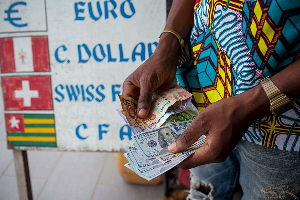
 File photo of Ghana cedi and US dollar notes
The recent exchange-rate movements in Ghana provide a compelling reason for the Bank of Ghana (BoG) and the Ghana Gold Board (GoldBod) to sustain their complementary roles in foreign-exchange management, notwithstanding criticism of their collaboration.
The cedi’s depreciation in September and its subsequent recovery in October 2026 demonstrate why the country needs both a dependable source of foreign-exchange supply and a central bank capable of intervening when market conditions threaten economic stability.
Ghana’s exchange-rate difficulties are not simply a question of confidence in the cedi. They reflect the underlying balance between foreign-currency earnings and demand, including the substantial dollar requirements of energy imports, businesses and other international payments. Managing these pressures requires coordinated action, not institutional rivalry.
September illustrated the challenge. The Bank of Ghana’s end-period interbank rate moved from GH¢11.25 to the dollar in August to GH¢11.71 in September, a depreciation of approximately 4.1 per cent during the month. The central bank also reported cumulative year to date depreciation of 10.76 per cent by the end of September.
Yet GoldBod was generating substantial foreign exchange from Ghana’s gold resources. Its September operations yielded US$1.871 billion, exceeding its monthly target of US$1.4 billion. Of this, US$701.3 million was sold to commercial banks, while US$1.170 billion was provided to the Bank of Ghana to support international-reserve accumulation.
These figures reveal the importance of distinguishing between generating foreign exchange, making it available to businesses and strengthening the country’s reserves. GoldBod can perform the first two functions, while the central bank must retain responsibility for the third and for orderly market conditions.
October’s developments reinforce the argument. GoldBod’s revised arrangements target US$1 billion in dollar sales to commercial banks and up to US$500 million for the central bank’s reserve accumulation. Its sales have helped improve dollar availability, with the cedi appreciating approximately 1.5 per cent between October 7 and 15, closing at GH¢11.65 to the dollar.
This recovery should not be interpreted as proof that the currency’s problems have disappeared. Rather, it illustrates how additional foreign-exchange supply can ease pressure when importers and other market participants are competing for dollars.
The criticism that GoldBod’s involvement somehow compromises the Bank of Ghana’s independence or makes central-bank intervention unnecessary is therefore misplaced. The two institutions have different, complementary responsibilities. GoldBod mobilises foreign exchange earned from gold exports and channels it into the market; the central bank oversees monetary and exchange-rate conditions, accumulates reserves and retains the capacity to intervene when excessive volatility threatens stability.
Indeed, the Bank of Ghana’s decision to reduce its own routine market sales as GoldBod assumes greater responsibility for intermediation should be understood as a practical division of labour, not an abdication of responsibility. The central bank has explicitly maintained its readiness to intervene when necessary.
That arrangement must, however, be transparent, disciplined and accountable. GoldBod’s dollar sales should follow clear allocation rules, while BoG interventions should address genuine market disorder rather than attempt to defend an arbitrary exchange-rate level. Both institutions must publish sufficiently detailed information for the public to assess their effectiveness.
The ultimate objective is not to manufacture a temporarily strong cedi through unsustainable dollar sales. It is to build a resilient foreign-exchange market supported by export earnings, adequate reserves and confidence in economic management.
Ghana’s gold resources offer an important opportunity to achieve that objective. The Bank of Ghana and GoldBod should continue working together to realise it.

Copyright © 1994 - 2026 GhanaWeb. All rights reserved.










