


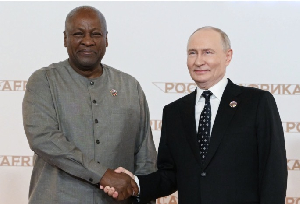
 President John Dramani Mahama of Ghana with Russian President Vladimir Putin
The International Perspective for Policy and Governance (IPPG) has raised concerns over the financial risks associated with Ghana's proposed 2,000-megawatt nuclear power project with Russia.
According to the organisation, the government must clearly explain how the project will be financed and the financial responsibilities of both countries before making any major commitments.
In a press statement issued on Tuesday, November 3, 2026, IPPG warned that the project could place pressure on Ghana's public finances and electricity tariffs if the funding arrangements and possible risks are not properly assessed.
Rare 1988 footage captures JJ Rawlings speak on IMF reforms and Ghana's economic crisis
"Given the capital-intensive nature of a 2000 MW nuclear power development, these arrangements will have significant implications for Ghana's public finances, electricity tariffs, and long-term fiscal exposure," the statement said.
The concerns follow an announcement by Foreign Affairs Minister Samuel Okudzeto Ablakwa on October 31, 2026, after President John Dramani Mahama's engagement with Russian President Vladimir Putin at the Russia-Africa Summit.
IPPG explained that although nuclear energy could help Ghana improve electricity supply and reduce dependence on other energy sources, the government must first consider the cost, technology and long-term benefits of the project.
"A commitment of this magnitude must be assessed not merely in terms of installed generation capacity, but against its economic viability, fiscal implications, and consistency with Ghana's long-term electricity demand and energy planning priorities," the organisation stated.
The group also questioned the type of nuclear technology being considered and whether Ghana's electricity system could support the proposed 2,000MW capacity.
It further urged the government to ensure that the country's nuclear regulatory bodies, safety systems and technical institutions were adequately prepared before moving ahead with the project.
IPPG stressed that the proposed partnership must follow Ghana's existing nuclear power development framework and meet the relevant requirements of the International Atomic Energy Agency (IAEA).
"IPPG maintains that the strategic merit of the proposed partnership will ultimately be determined by its ability to deliver reliable and affordable electricity without creating disproportionate fiscal liabilities or compromising established regulatory and project development processes," the statement added.
The organisation therefore called on the government to engage relevant stakeholders and provide clear information on the project's financing, technology selection, risk-sharing arrangements and implementation plans before making final commitments.
ANAS/MA
Dr Zanetor Challenges Workers: “Turn Your Skills Into Commercial Ventures”

Copyright © 1994 - 2026 GhanaWeb. All rights reserved.










