


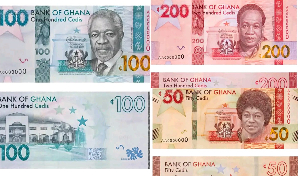
 The new Heritage Cedi Notes
Ghana has undertaken three major currency replacement exercises since introducing the first cedi in 1965, alongside several changes to the design and security features of its banknotes.
The latest development is the introduction of the Ghana Cedi Heritage Series, launched by President John Dramani Mahama on Thursday, November 12, 2026.
The new banknotes, which will enter circulation on December 1, 2026, feature improved security features, national heroes and symbols that reflect Ghana’s history and cultural heritage.
Here is a look at how Ghana’s currency has changed over the years.
The first cedi (1965)
Ghana introduced its first cedi and pesewa on July 19, 1965, under the leadership of President Dr Kwame Nkrumah.
The banknotes featured the portrait of Nkrumah. The name cedi was derived from the Akan word for cowrie shell, which was previously used as money.
10 key takeaways from Ghana's 2027 Budget
The New Cedi (1967)
Following the overthrow of Nkrumah in 1966, the military government introduced the New Cedi on February 17, 1967.
The new banknotes removed Nkrumah’s portrait. One New Cedi was equivalent to 1.20 of the previous cedi.
The replacement of cedi notes (1979)
In March 1979, the government introduced new cedi notes to replace the existing ones.
However, unlike a normal currency exchange, Ghanaians did not receive the full value of their old money when they exchanged it for the new notes.
The government deducted 30% from amounts up to 5,000 cedis, while amounts above 5,000 cedis attracted a 50% deduction.
For example, a person who had 1,000 cedis in old notes received only 700 cedis in new notes, while someone with 5,000 cedis received 3,500 cedis.
This meant that people lost part of their money during the exercise. The move was aimed at reducing the amount of money in circulation.
The redenomination of the cedi (2007)
In July 2007, under President John Agyekum Kufuor, Ghana introduced the current Ghana cedi by removing four zeros from the old currency.
This meant that 10,000 old cedis became GH¢1, while one million old cedis became GH¢100.
Unlike the 1979 exercise, people did not lose part of the value of their money. The exercise simply made it easier to count money, make payments and conduct business transactions.
Introduction of higher denominations (2019)
In November 2019, the Bank of Ghana introduced the GH¢100 and GH¢200 banknotes, as well as the GH¢2 coin.
The move was intended to make transactions involving large amounts of money easier.
The Heritage Series (2026)
The latest change introduces redesigned banknotes with improved security features and durability.
The new notes also feature national heroes, historical monuments and traditional symbols that reflect Ghana’s cultural identity.
Unlike the currency replacement exercises of 1979 and 2007, the Heritage Series does not change the value of the cedi.
New cedi notes to enter circulation on December 1 - BoG
The existing banknotes will remain legal tender and circulate alongside the new notes.
Since its introduction in 1965, the cedi has undergone several changes driven by political developments, economic challenges and the need to improve the security of Ghana’s currency.
DR/MA
New Cedi Notes to Circulate from December 1 – Bank of Ghana
Bank of Ghana Unveils New Cedi Notes with Stronger Security Features

Copyright © 1994 - 2026 GhanaWeb. All rights reserved.










