


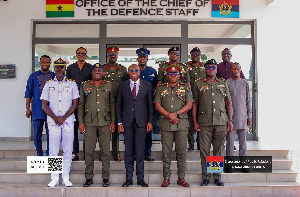
 The latest consultations have involved the Ghana Armed Forces and various ministries
Presidential Advisor on National Resilience and Emergency Preparedness, Ernest Brogya Genfi, has begun engaging key security and economic institutions as part of efforts to strengthen Ghana’s ability to deal with emergencies that threaten public safety and essential services.
The latest consultations have involved the Ghana Armed Forces, the National Commission on Small Arms and Light Weapons, the Narcotics Control Commission, and the Ministries of Energy and Green Transition, Transport, Environment, Science and Technology, and Atomic Energy.
The engagements form part of a nationwide assessment to identify weaknesses in Ghana’s emergency preparedness systems and determine how institutions can work together to prevent disasters and respond effectively when they occur.
Ghana’s private sector must contribute more to economy than government - Dangote
Brogya Genfi said the involvement of the energy, transport, environment and atomic energy sectors was necessary because threats to national resilience could come from different sources, including environmental hazards, industrial accidents, security threats and disruptions to critical infrastructure.
The assessment is therefore expected to examine the operational capacity of the institutions, the risks they face and the arrangements they have in place to respond to emergencies.
Beyond assessing individual institutions, the consultations are also aimed at improving cooperation among agencies, particularly in sharing information and coordinating resources during a crisis.
“The consultations are also expected to strengthen inter-agency collaboration and identify areas where institutional capacities, information-sharing systems and emergency response arrangements could be improved to ensure a more coordinated national response when crises occur,” Brogya Genfi said.
He said the broader ambition was to establish a system that would allow the country to identify threats early and ensure that institutions and communities were adequately prepared.
“Ultimately, the initiative seeks to build a national emergency preparedness system in which risks are identified early, institutions are adequately prepared, resources are effectively coordinated and communities are better equipped to withstand and recover from disasters,” he added.
The exercise follows a directive by President John Dramani Mahama for a comprehensive assessment of Ghana’s national resilience and emergency preparedness architecture. The findings are expected to inform a Comprehensive National Resilience and Emergency Preparedness Strategic Plan and an accompanying implementation framework.
The assessment comes against the background of recurring emergencies, including the June 29, 2026, flooding in parts of Accra, fire outbreaks at major commercial centres, the 2022 Appiatse explosion and the June 3, 2015 disaster. These incidents have exposed the human and economic costs of weaknesses in disaster preparedness.
As part of the exercise, Brogya Genfi has also engaged the Ministry of Communication, Digital Technology and Innovations, the National Signals Bureau and the National Centre for the Coordination of Early Warning and Response Mechanism.
BoG warns of rising food prices as El Niño threatens Ghana
Discussions with these institutions focused on intelligence, surveillance, risk monitoring and early-warning systems.
ANAS/MA
“The Cedi Knows No Political Parties” – President Mahama

Copyright © 1994 - 2026 GhanaWeb. All rights reserved.










