


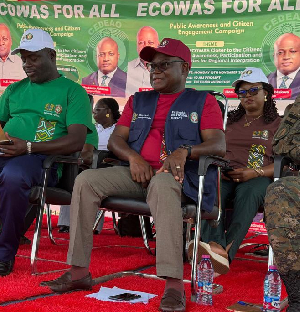
 Ambassador Francis Kotia in the middle
The Coordinating Director, Multilateral and International Organizations at the Ministry of Foreign Affairs, Ambassador Francis Kotia, says ECOWAS is about opportunities, rights and privileges for every Community Citizen and not just abstract treaties.
He said this when he addressed a stakeholder sensitization programme organised by the ECOWAS National Office of the Ministry of Foreign Affairs at the Elubo border on Monday, November 16, 2026.
The programme was under the theme: “Bringing ECOWAS closer to the citizens: Promoting Awareness, Participation and Opportunities for Regional Integration.”
Ambassador Kotia said Elubo was deliberately chosen for the programme because Elubo was not just a border post, but a crucial trading hub and gateway to commerce, livelihoods and brotherhood between Ghana and La Côte d'Ivoire and the wider West African region.
“What happens here affects the price of goods in our markets and the prosperity of families across our nation,” he said.
He said the programme formed part of a conscious campaign by the ECOWAS National Office to bring ECOWAS to the doorstep of the ordinary Ghanaian.
“We have been to the Makola Market; we have been to the Madina Market; we were at the Aflao border last week, and today we are here at Elubo border with the same message of ECOWAS regional integration,” he stated.
Ambassador Kotia said two questions most people continued to ask were: what is ECOWAS, and what benefits does one stand to gain as a citizen of ECOWAS?
He explained that ECOWAS was the principal regional economic community in West Africa established on 28th May, 1975, with a current membership of 12 States.
Its main objective, he said, was the promotion of regional integration, peace, stability and development across West Africa through free movement, free trade and collective security.
He listed the principal decision-making organs of ECOWAS as the Authority of Heads of State and Government, the Council of Ministers responsible for ECOWAS affairs, and the ECOWAS Commission, which is based in Abuja, Nigeria.
He added that ECOWAS had several institutions mandated to address concerns of Community Citizens, including the Community Parliament, which considers matters relating to Community laws, and the Community Court of Justice, which handles concerns and protects the rights of Community Citizens.
Touching on opportunities, Ambassador Kotia said through the ECOWAS Trade Liberalization Scheme (ETLS), goods of traders could enter the 12 Member States duty-free.
Through the ECOWAS Brown Card, he said, vehicles were insured across borders, and through the Free Movement protocols, citizens did not require a visa to travel to any of the 12 ECOWAS Member States for a period of 90 days.
“These statements are not abstract treaties, they are practical tools to make you more prosperous,” he said.
On rights and privileges, he said as an ECOWAS Citizen, one had the right of entry into any Member State, the right of residence and the right to establish a business, the right to be treated without discrimination, and the right to seek justice at the Community Court of Justice when a Community right was violated.
He, however, stressed that rights came with responsibilities.
“It is your responsibility to travel with a valid ECOWAS Passport (i.e. The Ghana Passport) or ECOWAS Identity Card (i.e. The Ghana Card) along with your Yellow Fever Card. It is your responsibility to respect the laws of the host country and to use the approved border crossings. It is your responsibility to engage in legitimate trade and finally it is your responsibility to refuse to pay bribe and report any acts of extortion,” he said.
Ambassador Kotia said the Ministry had listened to concerns raised by cross-border traders at the Makola Market, the Madina Market and the Aflao Border, and had noticed that most of the challenges faced by traders persisted not because there were no laws to protect them, but because of low awareness of those laws.
“This programme is therefore an empowerment exercise,” he said.
He said the team was not at Elubo to lecture the people, but to listen to them, and would give adequate time to market women, traders and transporters to share their practical daily experiences.
“We are not here to lecture you; we are here to listen to you. Every question is valid; every experience matters to us,” he said.
He urged participants to take what they learnt back to their markets, lorry stations and communities, and be ambassadors of ECOWAS integration.
“Contact the ECOWAS National Office with your concerns and the staff of the office will be glad to hear from you,” he added.

Copyright © 1994 - 2026 GhanaWeb. All rights reserved.










