



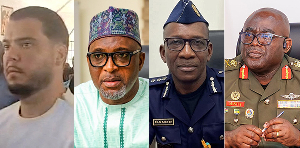
 From L-R: Desmond Koranteng linked to Bolle Jos, Muntaka Mubarak and other heads of state security
President John Dramani Mahama yesterday chaired a high-level meeting of security chiefs at which he received a detailed briefing on investigations into the trafficking of narcotic drugs through Ghana’s ports following the seizure in France of cocaine valued at US$261.45 million.
The president was informed that 10 individuals, including four officers of the Ghana Revenue Authority’s (GRA) Customs Division, are being held as investigations continue.
But while criminal proceedings have commenced against the suspects, their faces have yet to be publicly seen, with only selected information released to the media by security agencies.
A statement issued by Felix Kwakye Ofosu, Minister for Government Communications and Spokesperson to the President, did not name the suspects. Information subsequently emerged that six suspects had been arraigned before the Kwabenya Circuit Court in Accra on Thursday, September 17, 2026.
The six, whose activities have been linked to the Tema Port, are alleged to have been involved in the handling and clearance of four 40-foot containers which left Tema Port before being intercepted in France with approximately 3.9 tonnes of substances suspected to be cocaine.
The six have been identified as Francis Narh Amanor, Frank Adu-Boahen, Togbe Agbeti, Andrews Tetteh Amponsah, Daniel Laryea, and Helena Akua Denkyi.
The court denied them bail and remanded them in custody until September 24, 2026, while investigations continue.
Four of the six accused persons are linked to the GRA and face allegations concerning the Customs scanning process at Tema Port.
Meanwhile, four other suspects were arraigned before the Accra High Court on Wednesday, September 16, 2026, in connection with the same broader investigation. They have been linked to
The four have been identified as Desmond Koranteng Curiel, alias “Paul Kweku Yeboah” or “Biggs”; Musah Attah, alias “Kromo”; Kweku Otchere; and Jessica Hartog. They have links to East Legon, Accra.
They were arrested by the Narcotics Control Commission (NACOC) over an alleged conspiracy to export about four tonnes of cocaine from Ghana to France, said to have a street value of approximately €225 million.
The four were remanded in custody for four weeks and are to reappear on October 13, 2026.
Curiel, 34, is described as a business broker; Attah, 47, as a farmer; Otchere, 32, as a businessman; and Hartog, 34, as a beautician and the fiancée of Curiel.
They have been charged with conspiracy to commit a crime, namely the exportation of narcotic drugs without a licence, and the substantive offence of exporting narcotic drugs.
The case is being prosecuted under Sections 109(c) and 36(1) of the Narcotics Control Commission Act, 2020 (Act 1019).
The charge sheet alleges that four containers — SELU4549480, FFAU2242304, MSDU5642699 and SELU4809801 — were scanned before being exported.
According to the prosecution, the scan images were considered abnormal, raising concerns about the contents of the containers.
Despite the alleged abnormalities, however, the containers were cleared and subsequently left Ghana.
The prosecution alleges that some Customs officials responsible for analysing the scan images failed to take appropriate action.
The allegations have placed the Customs scanning process at the centre of the investigation, with investigators examining who reviewed the images, what was observed, what action was taken and why the containers were ultimately permitted to leave the country.
The charge sheet alleges that Frank Adu-Boahen provided his login credentials to other accused persons to conduct scan-image analysis on his behalf, although he was expected to perform the analysis himself.
The prosecution further alleges that abnormalities were detected in the images but that the containers were not subjected to further examination before being released.
Adu-Boahen is also alleged to have been the owner of the four containers.
Investigators reportedly arrested him at an alleged hideout at Community 19, Tema, on September 16.
According to the prosecution, Adu-Boahen admitted during interrogation that he owned the four 40-foot containers and had loaded them at a warehouse at Community 12, Tema.
He allegedly shipped the containers together with Francis Narh Amanor.
Amanor, described in the charge sheet as a freight forwarder and Managing Director of Fresna Commodities Ltd, was arrested on September 15.
The prosecution said checks through the Integrated Customs Management System (ICUMS) identified Fresna Commodities Ltd as the exporter, with Amanor’s telephone number listed as the exporter’s contact.
The same telephone number was reportedly associated with F&F Logistics, which was identified as the freight forwarder.
Amanor allegedly told investigators that he was the owner of F&F Logistics and had handled the export of the containers.
He reportedly said the containers contained pet flakes or plastic scraps.
The prosecution further alleges that Amanor identified Frank as the owner of the shipment who had engaged his services.
The six accused persons face charges including conspiracy to export narcotic drugs, exportation of narcotic drugs without the required licence, and abetment of the exportation of narcotic drugs, with the third charge directed at the four GRA officials.
According to the prosecution’s brief facts, NACOC received information in September 2026 concerning the interception at Dunkirk, France, of a 40-foot container originating from Ghana and declared to contain plastic waste.
Investigations allegedly established that the container contained about four tonnes of substances suspected to be cocaine, with an estimated street value of US$261 million.
French and Dutch investigators have reportedly linked the shipment to the criminal organisation of Dutch national Jos Leijdekkers, alias “Bolle Jos”, who remains at large.
Leijdekkers has been listed as a fifth accused person in the case.
The French and Dutch investigators had established links between the 3.9-tonne cocaine shipment seized last week at the port of Dunkirk in France and the criminal organisation of the fugitive Dutch drug kingpin “Bolle Jos”, who is hiding in Sierra Leone, West Africa.
NACOC subsequently commenced investigations into the shipment and identified the four accused persons as being connected to the consignment, according to the prosecution.
The first and fourth accused persons were arrested at Ashale Botwe on September 12, while the third accused was arrested at his residence at East Legon.
Searches allegedly led to the recovery of three guns, ammunition, four luxury vehicles, passports and various sums of money.
Attah was arrested on September 14 at NACOC headquarters.
The prosecution said Curiel, when questioned, identified himself as a businessman involved in various businesses and denied any knowledge of the shipment of narcotic drugs.
Attah reportedly described himself as Curiel’s friend and denied conducting any business with him.
Otchere allegedly told investigators that he was a long-standing friend of Curiel and was working on the construction of Curiel’s apartments at Tse Addo.
Hartog reportedly stated in her caution statement that she was Curiel’s fiancée and did not know the nature or details of his businesses.
NACOC said investigations were continuing to identify and arrest all persons allegedly involved in the exportation of the suspected narcotic drugs.
Under the first count, the accused persons are alleged to have, in September 2026, in the Greater Accra Region, agreed to act together with a common purpose to export about four tonnes of substances suspected to be cocaine from Ghana to France.
The second count alleges that they exported about four tonnes of substances suspected to be cocaine from Ghana to France.
NACOC is relying on officers stationed at its headquarters as witnesses in the case.
The development comes amid growing concern within Ghana’s security establishment over alleged insider involvement in narcotics trafficking.
Interior Minister Muntaka Mubarak has disclosed that foreign security counterparts are becoming hesitant to share intelligence with Ghanaian security agencies because of concerns about possible insider leaks.
He said foreign partners were uncertain whether sensitive information provided to Ghanaian authorities would remain secure or be compromised by officials allegedly involved in criminal activities.
“And now our counterparts abroad are even beginning to doubt [whether] to give us information because they trace it to an insider,” he said.
“So, they don’t know whether the insider, the minister, is part of it or the coordinator is part of it, and now you are asking them to give you information, meanwhile they have not finished with their investigation. Will the information be secured? Or it will also be abused?” he asked.
Muntaka made the remarks after alleging that some insiders within security agencies were aiding and abetting criminal activities.
He said the development was undermining confidence in Ghana’s security institutions and affecting cooperation with foreign counterparts.
“It is sad that even the recent case we are hearing, you hear it is insiders aiding and abetting criminals,” he said.
According to the Minister, personnel assigned sensitive responsibilities undergo training and background checks before being entrusted with such duties.
He said alleged abuse of such positions could have serious implications for Ghana’s ability to obtain sensitive intelligence from foreign partners.
“So, the situation that we have with the Australians is here; you see, they are dragging their feet. Now, we have one with France, the same,” he said.
Muntaka said he was scheduled to meet the French Ambassador to discuss the matter and seek greater cooperation.
He also criticised attempts to politicise security operations.
“When you go in to arrest some of them, then they begin to say because I am NPP, because I am NDC. We try to even politicise the security services?” he asked.
The minister stressed the need for personnel entrusted with sensitive responsibilities to change their attitude, warning that Ghana could not effectively tackle narcotics trafficking if insiders continued to compromise their positions.
“If we don’t change this attitude, there is no way we’re going to get angels coming from the sky to come and solve this problem for us,” he said.
Meanwhile, the government says President Mahama has directed the formation of an inter-agency task force to develop a detailed roadmap to prevent the trafficking of narcotic drugs through Ghana’s borders.
The directive followed yesterday’s meeting with the security chiefs, which reviewed the structure and security systems currently in place and considered additional measures to strengthen them.
The task force has been given two weeks to present its roadmap based on recommendations from the meeting.

Copyright © 1994 - 2026 GhanaWeb. All rights reserved.










