



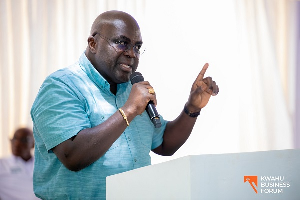
 A photo of Dr Julius Debrah, Chief of Staff
The Chief of Staff, Julius Debrah, has challenged Ghana's creative arts and media sector to work more closely with academia to improve the country's presence in the international entertainment industry.
Speaking at the induction of Dr Ernest Ofori Sarpong as UniMAC's first Chancellor, Mr Debrah urged the new Chancellor to use his private-sector experience and influence to help the university train more filmmakers, musicians and writers capable of competing internationally.
He said Ghana had significant creative talent but needed stronger collaboration between industry players and academic institutions to translate that potential into international recognition.
"In the private sector, you will be able to help this university to see how best we can train more of our filmmakers, our musicians, and our writers to take our rightful position on the universal stage," he said.
Mr Debrah questioned why Ghanaian creative productions appeared to lag behind those from other countries on international entertainment platforms, particularly in music and film.
He recounted instances where music from other African countries featured prominently outside the continent, while films from certain countries received greater visibility on international airline entertainment platforms.
"When you go to several countries outside Africa, you hear particular music being played from a sister country and ask yourself when we are going to catch up," he said.
"When you sit in any international aircraft, you see movies listed and there seems to be a particular people whose movies are shown."
He challenged Dr Ofori Sarpong to make Ghana's international creative industry presence a key part of his legacy as Chancellor.
"My charge to you today is to take it upon yourself that at the end of your tenure, you will help Ghana get a rightful position as far as international theatre arts are concerned," he added.
The Chief of Staff expressed optimism that combining private-sector investment with academic expertise could produce significant results for Ghana's creative economy.
"I believe a few years from now, when we gather here, we will all be proud that we combined the efforts of private entrepreneurs with academia," he said.
His remarks place particular emphasis on the potential role of UniMAC in developing talent and building stronger links between formal education and the commercial creative industries.
The university, established through the merger of the Ghana Institute of Journalism, the Ghana Institute of Languages and the National Film and Television Institute, has a mandate covering media, communication and the creative arts.
The call comes as the creative industry increasingly competes across international markets, where visibility, production quality, distribution networks and investment are important to the success of music, film and other creative products.
EA

Copyright © 1994 - 2026 GhanaWeb. All rights reserved.










