



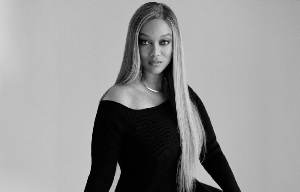
 Tyra Banks was the Executive producer and host for the America’s Next Top Model series
Tyra Banks has sued Netflix and the directors of its documentary series “Reality Check: Inside America’s Next Top Model” for defamation, claiming that the producers used hours of interview material to fabricate a story.
The model who created and hosted “America’s Next Top Model” claimed in the lawsuit filed on June 13 in a federal court in Los Angeles that she was interviewed for three and a half hours, during which time she accepted responsibility for some of the contentious choices made by the show, according to the Associated Press.
The lawsuit claimed that those interviews were altered and cut down to just 16 minutes “to support a false and defamatory narrative unrelated to what she actually expressed.”
“The accountability Ms. Banks took ended up on the cutting room floor. It was there, but viewers were never given the opportunity to see it,” her lawyers wrote.
Banks seeks damages in her lawsuit against Netflix, directors Daniel Sivan and Mor Loushy, and EverWonder Studio. She is also seeking an injunction to prevent the use of her image in connection with the docuseries’ soundtrack, released as an album.
Launched in 2003, “America’s Next Top Model” ran for 24 seasons. Due to allegations of body shaming, contestant manipulation, and problematic photo shoots, the reality competition series has undergone a critical reevaluation in recent years. In response to those criticisms, Banks acknowledged “some really off choices” and “the insensitivity of past ANTM moments.”
According to the lawsuit, the Netflix docuseries’ producers used “selective editing, deliberate omission, and surgical manipulation of continuous footage” to create the impression that Banks permitted a contestant to be sexually assaulted on the show, exploited the contestant’s trauma to increase viewership, and then was unable to recall it when questioned during the interviews.
The lawsuit claimed that Banks had not been informed or questioned about the sexual assault during the interview.
The suit argued, “Defendants edited the Netflix series to make it appear that Ms. Banks knew she was being asked about a sexual assault and was intentionally trying to evade the topic.”
According to Banks’ attorneys, she was not allowed to watch the documentary series until the day before its February 16 release.
They added that she was not contacted for fact-checking following her interviews and was not given a chance to address allegations made by other participants, according to the lawsuit. The docuseries consulted with other judges from the show, one of whom her attorneys claim harbors resentment toward Banks.
“Had Ms. Banks known these individuals were so deeply involved in the formulation of the Netflix Series, also serving as consultants shaping the editorial direction, and that she had been excluded from such a role, it would have raised a red flag,” the lawsuit read. “She would have known she was being set up. She would not have participated.”
In March, Banks’ attorneys contacted Netflix to request access to the full video of her interviews. The lawsuit claimed that Netflix and EverWonder rejected that request.
The lawsuit stated that the public’s response to the docuseries has been “swift, harsh, and directed squarely at Ms. Banks,” adding that even her Sydney, Australia-based ice cream shop, SMiZE & DREAM, has been targeted in Google reviews.

Copyright © 1994 - 2026 GhanaWeb. All rights reserved.










