



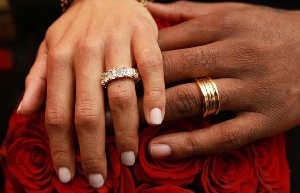
 File photo of male and female wedding rings
Every time someone slips a wedding ring onto the fourth finger, they’re taking part in a tradition that has survived for thousands of years.
But here’s the twist: one of the biggest reasons for wearing it on that finger is based on a belief that modern science has long disproved.
Long before anatomy was properly understood, the ancient Egyptians believed the fourth finger of the left hand contained a special blood vessel that ran directly to the heart.
A belief that the Romans later embraced, giving it the Latin name vena amoris, meaning “the vein of love.”
According to them, the heart was the center of love, emotion, and devotion. Wearing a ring on that finger wasn’t just symbolic; they believed it physically connected two lovers’ hearts through this unique vein.
The Evolution of Ghanaian Marriage: From custom to celebration extravaganza
The idea became so deeply rooted that it outlived the civilizations that created it. As wedding traditions spread across Europe and eventually much of the world, the ring finger became the accepted place for wedding and engagement bands.
However, centuries later, advances in medicine revealed something surprising.
Modern anatomy has shown that there is no special vein linking the ring finger directly to the heart.
Instead, every finger shares a similar network of veins and arteries that connect to the body’s circulatory system. The so-called vena amoris simply doesn’t exist.
Yet the discovery did little to change the tradition.
Today, millions of couples still exchange rings on the fourth finger not because of biology, but because of the enduring romance attached to the story.
In many Western countries, rings are worn on the left hand, while in several parts of Eastern Europe, Asia and other regions, the right hand is traditionally preferred, showing that customs have evolved differently across cultures.
The wedding ring itself also carries symbolism beyond the mythical vein. Its circular shape, with no beginning or end, has long represented eternity, endless love and lifelong commitment.
Historians trace the use of wedding rings back more than 4,800 years to ancient Egypt, where couples exchanged rings woven from reeds and papyrus before precious metals became the norm.
So while the famous “vein of love” may never have existed, its legacy certainly does.
Sometimes, the most enduring traditions aren’t built on scientific fact; they’re built on stories.
And in the case of the wedding ring, a beautiful myth has become one of humanity’s most recognisable symbols of love, proving that romance can outlast even the facts that inspired it.
Additional files from Jewelers Mutual, Discover Magazine, Encyclopaedia, Britannica, Cleveland Clinic, GIA (Gemological Institute of America
PAT/EB

Copyright © 1994 - 2026 GhanaWeb. All rights reserved.










