



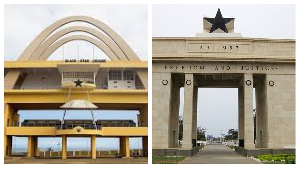
 The Black Star Gate and the Independence arch are symbols of freedom
Standing in the heart of Ghana’s capital city, Accra, is Independence Square, widely known as Black Star Square.
It is one of the country’s most iconic public spaces and the symbolic center of Ghana’s national identity.
The square serves as the principal venue for military parades, state ceremonies, and cultural events, most notably the annual Independence Day celebration on March 6, marking Ghana’s liberation from British colonial rule.
But what is the story behind this architectural monument, and what is its significance to Ghana’s independence?
Commissioned by Osagyefo Dr. Kwame Nkrumah, Ghana’s first Prime Minister and President, the square was envisioned as a monumental public space reflecting Ghana’s newfound status as the first sub-Saharan African country to achieve independence under majority rule.
Construction began in 1960 and was completed in 1961, intentionally timed to coincide with the state visit of Queen Elizabeth II, a major diplomatic event in the early years of independence.
Originally called Independence Square, it soon became better known as Black Star Square, referencing the Black Star of Africa, a potent symbol of African emancipation adopted in Ghana’s flag and national ethos.
Spread between 28th February Road and Accra’s southern coastline, the Independence Square is designed to accommodate tens of thousands of people.
Its perimeter is lined with grandstands that seat about 30,000, where citizens and guests gather during major celebrations.
Ghana Month: The story of the National Theatre
The square is framed by three principal monuments, each carrying deep national and Pan-African symbolism:
Independence Arch
A towering triumphal arch that marks Ghana’s freedom and national pride.
It bears the inscription “Freedom and Justice”, Ghana’s national motto, and is crowned with the Black Star, symbolizing not only Ghana’s independence but also unity with the broader African liberation movement.
Black Star Gate
Also called the Black Star Monument, this structure stands prominently within the square and represents Ghana’s sovereign power and continental leadership.
Its inscription “AD 1957” commemorates the year of independence.
Liberation Day Monument
This monument honours Ghanaian veterans and those who sacrificed their lives during the struggle for independence and World War II.
Beyond its statuary and symbolism, the square’s architectural elements, broad open spaces, monumental forms, and the dramatic arch reflect both Ghana’s aspirations at the dawn of independence and Dr. Kwame Nkrumah’s Pan-Africanist vision of unity and progress.
National and Cultural Importance
Since its inauguration, Independence Square has been the central stage for Ghana’s national ceremonies.
Each year on March 6, the site hosts the official Independence Day parade, featuring military formations, cultural displays, political speeches, and patriotic celebrations.
This ritual reinforces unity and national pride across generations.
As Ghana approaches its 69th Independence anniversary, Independence Square remains a dynamic symbol of national history and civic life.
Through its monuments, parades, and gatherings, Black Star Square continues to connect the present to the momentous events of 1957 and to the enduring ideals of freedom, unity, and justice that define modern Ghana.
PAT/EB

Copyright © 1994 - 2026 GhanaWeb. All rights reserved.










