



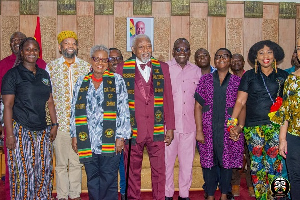
 Pax Nindi said that carnival is a lucrative business capable of generating significant revenue
The Chief Executive Officer of the World Carnival Commission (WCC), Pax Nindi, has described carnival as one of the biggest income-generating ventures with immense potential to boost Ghana’s economy.
Speaking in an interview with journalists in Accra over the weekend, Nindi emphasised the economic benefits of carnival, noting that Ghana has yet to fully tap into its potential.
“Ghana is sitting on a goldmine but does not know it. We have come to guide, present, and share our experiences to help uncover this goldmine,” he said.
He added that carnival is a lucrative business capable of generating significant revenue.
“It is a business that generates a lot of money, and we have come to show where the money is hidden.”
Drawing comparisons with other countries, Nindi noted that Brazil invests heavily in carnival and reaps substantial returns.
According to him, Brazil spends about £200 million on carnival and generates approximately £1.5 billion in profit.
He also cited Goa in India, where authorities reportedly invest about $10 million and generate close to $1 billion in returns from carnival activities.
“These are examples Ghana can learn from. Unfortunately, many governments are reluctant to invest in carnival, and Ghana is missing out,” he said.
Nindi stressed that with proper strategy, Ghana could generate significant revenue from carnival tourism, highlighting the country’s reputation as a safe destination compared to some other African countries.
Globally, carnival, particularly Caribbean-influenced festivals, accounts for over 300 events, attracts more than 50 million participants, and generates an estimated $15 billion annually.
He called for increased investment in digital education for carnival, international collaborations, knowledge sharing, and the promotion of creativity while preserving cultural heritage.
Nindi also underscored the need to train young people to become carnival producers.
“I started training young people to produce carnival four years ago, and it has been successful, with many of them now working in Dubai and other countries,” he revealed.
He urged stakeholders to invest in youth development, noting that Ghana’s flexible regulatory environment offers a competitive advantage.
The WCC CEO further highlighted the importance of utilising local resources, such as palm trees, to produce costumes instead of relying on imported materials.
“These are the kinds of initiatives we want to encourage as a commission,” he said.
Nindi emphasised that Ghana already possesses the necessary cultural assets to build a thriving carnival industry.
“Sometimes we spend too much time looking outside for solutions when the answer is already here. Ghana has the culture, the talent, and the people. What we need now is organisation and belief, and the Black Star Carnival will become a lasting legacy, not just an annual celebration,” he added.
He explained that in Africa, the concept of carnival is often misunderstood.
“In Ghana, carnival is associated with masquerading and fancy dress, which many people overlook. However, in the West, masquerading and fancy dress are not necessarily seen as carnival but rather as parties. We aim to clarify these concepts and make the carnival more attractive,” he said.
Nindi made these remarks during the WCC team’s visit to Ghana to support the Ghana Federation of Masqueraders and Fancy Dress (GFMFD) in preparing for the upcoming Black Star Carnival. The delegation included Henry Lewis Antonie, President of the Commission, and Jemma Jordon, Deputy Communications Officer.
Nindi commended the federation for engaging the WCC, describing it as a step in the right direction.
“The federation has chosen the right team. We bring experience and direction that will positively impact the carnival,” he said.
During their visit, the team engaged key institutions, including the Ministry of Tourism, the Ministry of Youth and Sports, the National Youth Employment Agency, and some Members of Parliament to deepen understanding of the carnival industry.
He revealed plans to organise a three-day international conference that would bring together stakeholders from countries such as the Bahamas, Colombia, Trinidad and Tobago, and Brazil.
Participants are expected to stay in Ghana for one to two weeks, boosting tourism and the local economy. Following the conference, a report will be produced to promote the Black Star Carnival internationally.
“When participants return to their countries, they will promote Ghana’s carnival, helping to position it globally,” he explained.
Nindi also expressed optimism about growing support within government, noting that some policymakers are already involved in masquerading and fancy dress activities. He further shared his experience supporting carnival development in countries such as South Africa and England.
The Black Star Carnival aims to bring together masqueraders, fancy dress groups, and industry players under one umbrella to enhance recognition and collaboration with government. However, he identified political discontinuity as a major challenge, citing the tendency for projects to be abandoned when governments change.
President of the Commission, Henry Lewis Antonie, emphasised the economic value of investing in carnival artists.
“If you invest in carnival and its artists, you receive twofold or more in returns,” he said.
He added that carnival showcases cultural heritage, celebrates tradition, and fosters national unity.
“This is why the Black Star Carnival should not be limited to an annual celebration. It can create jobs, build national pride, and attract global attention. People will begin to ask, ‘When is Ghana’s carnival?’”
Antonie further highlighted the potential for global collaboration, cultural exchange, and the use of technology to drive sustainability and growth in the sector.
“Carnival can inspire a new generation of artists and designers,” he added.

Copyright © 1994 - 2026 GhanaWeb. All rights reserved.










