



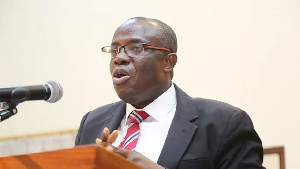
 Justice Adjei calls for reintroduction of folklore and music to expose corruption
Justice Sir Dennis Dominic Adjei, a Justice of the Supreme Court and Fellow of the Ghana Academy of Arts and Sciences, has called for the revival of Ghanaian folklore and music as a tool to publicly expose corrupt individuals.
He argued that such traditional practices could still be as effective today as they were in earlier times in addressing social misconduct by identifying and shaming offenders.
He made the remarks during the Ephraim Amu Memorial Lecture held at the Ghana Academy of Arts and Sciences (GAAS) in Accra on May 28, 2026.
Justice Sir Adjei noted that many songs have long carried messages about human rights and have been widely embraced by audiences, making music a strong channel for promoting rights-based education and awareness.
A chorister and composer himself, he urged deliberate efforts to embed human rights themes into mainstream Ghanaian music.
He further proposed that the Ministry of Education could pilot such songs within moral education curricula, while the Ministry of Lands and Natural Resources could support the integration of environmental protection messages into music as part of the national fight against illegal mining.
He added that collaboration with the Ministries of Health, Food and Agriculture, and Environment, Science, Technology and Innovation would help strengthen this effort.
Save children, end insecurity – Davido, Victony, Timaya tell Tinubu
In a presentation enriched with choral performances, he reflected on earlier times when music at festivals was used to expose wrongdoing and defend community rights.
He also suggested that the National Folklore Board, under the Ministry of Tourism, Culture and Creative Arts, work with the Ghana Library Authority and relevant NGOs to record, digitise and preserve songs linked to social movements, helping to protect cultural memory in a context where oral traditions remain important.
He added that funding could be sourced through the National Film Authority’s Creative Arts Fund.
"The National Folklore Board, under the Ministry of Tourism, Culture and Creative Arts, in collaboration with the Ghana Library Authority and appropriate non-governmental organisations, should record, digitise and preserve songs created during social movements to protect cultural memory from erasure when oral testimony is central.
Funding may be sought through the National Film Authority’s Creative Arts Fund,” he said.
The proposal received a warm reception from attendees, including former Speaker of Parliament Aaron Mike Oquaye, Asokoremanhene Dr SKB Asante, MP for Okaikwei Central Patrick Yaw Boamah, legal practitioner and NDC member Kakra Essamuah, past GAAS presidents and students.
Justice Sir Adjei also recommended creating safe platforms for musical advocacy through district assemblies, religious institutions and the National Commission for Civic Education (NCCE).
He encouraged both public and private media outlets to offer free airtime during peak hours to promote rights-based music.
He further suggested incentives for musicians who produce advocacy content, as well as tax waivers for media houses that support and broadcast such material during prime time.
He pointed to traditional festivals that use music to publicly call out misconduct, such as the Apoo and Alolue festivals celebrated by the Bono and Sefwi people, respectively, saying these could be harnessed in efforts to address illegal mining activities within communities.
He also recommended research into whether music-based interventions can actually shift public attitudes and knowledge, adding that such findings could support sustained funding from key ministries, including Lands and Natural Resources, Environment, and Tourism.
The Justice further urged the Ministry of Education to ensure that patriotic songs with human rights themes are included in school assemblies and inter-school events.
He emphasised that music remains a powerful educational tool that enhances learning and memory, alongside methods such as storytelling, visual aids, group discussions, role-play and practical activities.
“Songs are a universal language that is understood worldwide, irrespective of the language in which they are sung, and they become easy to memorise,” Justice Adjei said.
Ak/BAI
Cabinet walkout, premature campaigns trigger Mahama and NDC Elders' crackdown:

Copyright © 1994 - 2026 GhanaWeb. All rights reserved.










