



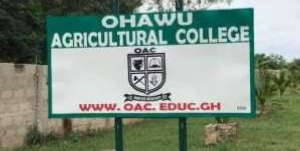
 Ohawu Agricultural College (OAC) was established in 1964 by the Ministry of Food and Agriculture
Education is often described as the bedrock of national development, and in Ghana, the urgency to expand access to higher learning has never been greater. In the Southern Volta Region, where towns such as Dzodze, Weta, Afife, Penyi, and Ohawu play a vital role in the nation’s agricultural output, a bold vision is emerging: the transformation of Ohawu Agricultural College into a fully-fledged university.
This proposal, championed by the National Democratic Congress (NDC) and strongly advocated by Hon. Edem Agbana, Member of Parliament for Ketu North, is not merely an educational initiative. It represents a transformative step that could reshape agriculture, research, and economic development across the region.
An agricultural powerhouse in waiting
Ketu North is renowned for its fertile lands, with rice farming forming the backbone of local livelihoods. Vast fields in Afife and Weta feed households and bolster national food security. Yet, despite this potential, the absence of advanced agricultural research institutions has long constrained progress. Farmers often lack access to modern techniques, value addition opportunities, and climate-smart practices that could transform yields.
Upgrading Ohawu Agricultural College into a university would directly address this gap. It would offer specialized training and applied research tailored to local realities, equipping farmers and students alike with the tools to modernise agriculture and strengthen food systems.
Decentralising higher education
For young people in Southern Volta, higher education often means relocating to cities like Accra, Kumasi, or Cape Coast, an expensive journey that many cannot afford. A university in Ohawu would change that equation, bringing quality education to the doorstep of rural communities.
Beyond expanding access, the institution could pioneer new academic programmes in agribusiness, environmental science, and technology, fields critical to Ghana’s 21st-century development agenda. For many students in Dzodze, Penyi, Afife, and Weta, it would provide a fair chance to pursue university education without the barriers of cost and distance.
Driving research and innovation
The vision extends far beyond lecture halls. A university at Ohawu could become a hub for agricultural research, working hand-in-hand with local farmers to improve seed varieties, develop irrigation systems, and introduce mechanisation. Rice farmers in Afife and Weta, for example, stand to benefit from direct collaboration with researchers developing solutions for pest control and sustainable production.
This symbiotic relationship, where academia fuels practice and practice informs academia, could position Ketu North as a model for integrating education with community development.
A catalyst for economic growth
The ripple effects of such a transformation would be felt across Southern Volta. New infrastructure such as lecture theatres, student hostels, and laboratories would stimulate construction jobs and boost local businesses. Markets in Dzodze and Penyi could experience increased trade, while transport and hospitality services would expand to meet new demand.
In short, an Ohawu University would be more than an educational institution; it would be an economic engine for the region.
Leadership and vision
Hon. Edem Agbana has been vocal about the need to elevate education in Ketu North. His efforts to supply schools with computers and bridge the digital divide and his support for the over 450 tertiary students through his scholarship scheme reflect a broader vision to empower young people with knowledge and opportunity. By pushing for the upgrade of Ohawu Agricultural College, he has underscored his belief that education is the foundation of sustainable development.
This aligns with the NDC’s wider commitment to equitable access to education and regional growth. But the vision cannot remain on paper. It requires urgent political will and investment.
A national imperative
The Ministry of Education and the Government of Ghana face a clear choice. Transforming Ohawu Agricultural College into a university is not simply a regional request; it is a national imperative. It speaks directly to Ghana’s goals of decentralising education, boosting agricultural productivity, and securing food self-sufficiency.
For Southern Volta, the project is overdue. For Ghana, it is indispensable. A university at Ohawu would stand as a beacon of what is possible when education and agriculture converge to power development.
Meanwhile, watch the trailer to GhanaWeb’s yet-to-air documentary on teenage girls and how fish is stealing their futures below:

Copyright © 1994 - 2026 GhanaWeb. All rights reserved.










