



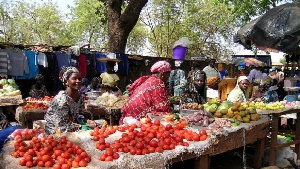
 23.96 percent of Ghanaians were unable to consume sufficient food as of November 2025
The word famine is not used lightly. It carries the weight of history — of the Irish Potato Famine, of the Ethiopian famines of the 1980s, of the Sahel crises that defined a generation's understanding of African hunger.
Ghana is not there yet. But the conditions that lead there — floods destroying farms, farmers abandoning production because they cannot recover their costs, eight million people already unable to consume sufficient food, food prices rising again after months of relief, the North East Region recording 10.1 percent inflation in May 2026 alone — these conditions are not abstractions.
They are the data points of a country moving in the wrong direction. And if what is happening to Ghana's farms, its farmers, and its flood-vulnerable food systems continues unchecked, the possibility of a serious food crisis is not a distant nightmare.
It is a trajectory. This article names that trajectory — and what must be done, urgently, to change its course.
The paradox that should alarm every Ghanaian
Ghana is, by every measure of agricultural output, a food-producing country. The 2025 harvest season was strong.
The National Food Buffer Stock Company's warehouses were described as overflowing.
The Alliance for a Green Revolution in Africa's November 2025 Food Security Monitor, produced with support from the UK Government's FCDO, the Bill and Melinda Gates Foundation, and the Rockefeller Foundation, documented exactly this: national harvests surging, silos full, production records approaching.
And yet — 23.96 percent of Ghanaians, representing approximately eight million people, were unable to consume sufficient food as of November 2025. That is not a figure from a drought year.
That is a figure from a bumper harvest year. The AGRA report calls it the Paradox of Plenty: a country where the warehouses are full and the stomachs are empty.
Food security in Ghana is not primarily a production problem today. It is an access problem, an affordability problem, a distribution problem, and — crucially — a policy problem. And those problems are about to be compounded by the most serious flood season Ghana has experienced in years.
THE FOOD SECURITY SNAPSHOT: 8 million Ghanaians — nearly 1 in 4 — face
insufficient food consumption. Food insecurity has risen 55.6% since 2023.
The Volta Region recorded 50.1% food insecurity in Q3 2025 — second highest in the country. The Upper West Region recorded 55.9%.
Female-headed households face higher rates than male-headed ones. And this is BEFORE the June-July 2026 floods have destroyed this season's crops.
The Ghana Statistical Service's own data for the third quarter of 2025 confirmed the regional crisis: the Volta Region recorded a food insecurity rate of 50.1 percent — meaning more than half of the households surveyed in the region were experiencing insufficient food consumption.
This is the region most directly in the path of the Volta River's flood corridor. This is the region whose farms have just been submerged.
This is the region where I live and write from. A region where half the people were already food insecure is not a region that can absorb another season of crop destruction without moving toward a crisis with the characteristics of famine.
What the floods are doing to Ghana's farms right now
Floods do not merely destroy what is already planted. They destroy the ground in which the next season's crops will be planted.
They salt the earth with waterlogging that prevents planting for weeks or months after the water recedes. They wash away the topsoil that generations of farming have built up.
They destroy stored grain and seed reserves that farmers depend on for the following season. They kill livestock.
They damage the farm tools, the irrigation equipment, and the storage facilities that determine whether a farmer can recover. And they do all of this simultaneously, to multiple farmers, across multiple communities, in multiple districts, at exactly the moment when those farmers are most financially vulnerable.
The science is unambiguous. Research across sub-Saharan Africa — including studies specifically on Northern Ghana, the Afram Plains, and the Volta Region — consistently confirms that flood events reduce crop yields by 20 to 50 percent in affected areas.
IFRC assessments of previous major flood years in Ghana documented up to 50 percent of staple crops destroyed or rotting in flooded fields.
The Famine Early Warning Systems Network, which monitors food security across Africa, specifically identifies flooding as a primary trigger of food crisis in Ghana's northern and central regions.
In the Western Region, where cocoa is the primary cash crop and subsistence farming sustains the majority of the rural population, the June 2026 floods have submerged farms across Wassa Amenfi West Municipality.
A farmer named Samuel Nartey watched his house collapse into floodwaters. Behind that house were almost certainly the crops, the tools, and the food reserves that his family depended on. He is not alone.
In the Central Region, 13 districts were hit by torrential rains that killed 18 people. Those rains did not discriminate between human beings and agricultural land.
Farms across those 13 districts have been damaged or destroyed.
In the Volta Region, South Tongu's farms are underwater.
The flat, low-lying terrain of the South Tongu District — ideally suited for the cultivation of rice, cassava, maize, beans, and okro — is the same terrain that floods most deeply and drains most slowly when the rains are severe.
A farm that is submerged for two weeks does not recover in two weeks. The soil requires time to dry, to drain, and to be prepared for replanting. That time eats directly into the growing season. And a growing season cut short by flooding is a harvest reduced — or destroyed entirely.
Floods do not just destroy this season's harvest. They destroy next season's capacity to plant. When the water recedes, what is left is not a farm ready for a new season. It is a waterlogged, depleted, tool-less, seed-less shell of one.
The farmer crisis that was already breaking Ghana before the floods
Here is the dimension of the food security crisis that makes the flood damage exponentially more dangerous: Ghana's farmers were already in crisis before a single farm flooded this year.
The January 2026 report — 'From Plenty to Penury: The Crushing Crisis on Ghana's Farmlands' — documents a agricultural system in which the economics of farming have broken down entirely for smallholder producers.
In the Northern Region, hiring a combine harvester costs between GH₵500 and GH₵600 per acre.
The farm-gate price for 100 kilograms of paddy rice hovers between GH₵150 and GH₵300. The yield from one acre often fails to cover the harvesting cost alone. Maize sells for approximately GH₵250 per bag.
Soya beans, which require labour-intensive hand harvesting, fetch only GH₵400. As Adam Sandow Saani — a farmer, supply chain professional, and lecturer at Tamale Technical University — put it with devastating clarity: 'We are not talking about low profit. We are talking about a direct path into debt. There is no breakeven point in sight.'
The National Food Buffer Stock Company, established specifically to stabilise food prices and provide a guaranteed market for local producers, has been inconsistent in its support.
Reports indicate that Senior High Schools — which should provide a reliable institutional market for Ghanaian food — are being supplied with imported parboiled rice from Burkina Faso, undercutting local producers at the exact point in the value chain where domestic demand should be strongest.
The government committed GH₵200 million to NAFCO in the 2026 Budget — but the structural problem of market access and fair pricing for farmers remains unresolved.
The consequence is the one that food security analysts most fear: farmers are making the decision to reduce planted acreage next season.
Not because the land is infertile. Not because the seed is unavailable. But because the economics of planting, harvesting, and selling have become so unfavourable that planting more food produces more debt, not more income.
As the AGRA report warned with unusual directness: today's celebrated low consumer prices are a mirage foreshadowing tomorrow's severe shortages and price spikes. The warehouses are full today because farmers produced at a loss.
They will not produce at a loss indefinitely. When they stop, the warehouses will empty — and by then, the floods will have already reduced the harvest available to fill them.
The Inflation Signal: Waht the numbers are already saying
Ghana's headline inflation has been on a remarkable downward trajectory. From 18.4 percent in May 2025 to 3.7 percent in May 2026 — a fifteen-month decline that the Mahama government rightly highlights as a macroeconomic achievement.
The Ghanaian cedi's 35 percent appreciation against the US dollar in 2025 has moderated import costs and reduced pressure on food prices from the currency channel.
But the May 2026 data contains a warning that must not be glossed over in the celebration of the headline number.
Food and non-alcoholic beverage inflation rose to 3.3 percent in May — driven by a 2 percent month-on-month increase in food prices in a single month, described by the Government Statistician as the most significant monthly increase since February 2025.
Fresh tomatoes were a top contributor to inflation. Green plantain was another. These are not imported commodities whose prices fluctuate with the exchange rate. They are domestically produced staple foods whose prices reflect the supply conditions of Ghanaian farms.
The regional picture is even more alarming. The North East Region recorded 10.1 percent year-on-year inflation in May 2026 — nearly three times the national average. The Volta Region recorded 5.2 percent.
The Central Region contributed 11.8 percent of total national inflation — a disproportionate share from a region that has just been hit by the flooding deaths of June 2026. These are the pre-flood numbers.
They are the baseline against which the food price impact of the June-July 2026 floods must be measured. And they are already elevated.
The June 2026 inflation figure — incorporating the food supply disruption from the Western Region displacement, the Central Region deaths and damage, and the Volta Region farm inundation — has not yet been published.
When it is published, in early July, it is likely to show further upward pressure on food prices, particularly for locally produced staples. And the July figure, incorporating the compound impact of continued flooding and reduced harvest expectations, may be worse still.
The Chain: From flooded farm to empty plate
Food crises do not arrive suddenly. They build through a chain of connected failures, each one making the next worse. Understanding that chain — and where it can be broken — is the difference between early intervention and emergency response.
The first link in the chain is the farm. When floods submerge farms, crops are destroyed and the growing season is disrupted.
Farmers lose not just the current harvest but the resources — seeds, fertiliser inputs, stored food — needed for the next planting. Without those resources, the next season's planting is reduced or delayed, reducing the following harvest before it is even planted.
The second link is the farmer. A farmer who has lost a harvest and cannot recover costs does not simply replant and try again.
They take on debt — at the high interest rates that Ghana's rural credit market imposes on smallholders without collateral. Or they reduce their planted acreage, because the risk of another loss is too great. Or they abandon farming entirely, moving to urban areas in search of alternative livelihoods.
Ghana's agricultural workforce is already under pressure: the AGRA report documents farmers planning production cuts even in a non-flood year because the economics are broken.
A flood year accelerates every one of those decisions toward the worst possible outcome for food supply.
The third link is the market. When farm production falls, local market prices for affected crops rise.
For urban consumers — already squeezed by the legacy of Ghana's 2022–2024 inflationary crisis, which pushed food inflation to 14.8 percent in August 2025 — price increases in staple foods translate directly into reduced food consumption.
The Agribusiness Chamber of Ghana has called Ghana's food crisis a security threat, citing the compressing of household purchasing power as the sharpest impact felt by urban and peri-urban communities.
The poor and near-poor — who spend the highest proportion of their income on food — are hit hardest and fastest.
The fourth link is the buffer. Ghana's National Food Buffer Stock Company exists precisely to break this chain — to buy when production is high, store strategically, and release when production falls, moderating the price impact for consumers.
But NAFCO's inconsistent purchasing, its competition with subsidised imports, and the Ministry of Finance's delays in releasing allocated funds have weakened the buffer precisely when it is most needed.
A buffer that is funded on paper but not in practice is not a buffer. It is a bureaucratic fiction.
The fifth and final link is the response. When food prices rise and the poor cannot afford to eat, the state must intervene — through food assistance programmes, through subsidised distribution, through targeted cash transfers to the most vulnerable.
Ghana has the LEAP programme. It has the school feeding programme. It has the institutional frameworks for emergency food response.
What it has historically lacked is the speed, scale, and funding to deploy those frameworks before malnutrition begins to rise among the most vulnerable populations — children, pregnant women, nursing mothers, and the elderly.
Famine is not an event.
It is the end of a chain of failures — each one preventable, each one made worse by the one before it. Ghana is at the beginning of that chain, not the end. The window to break it is now.
The Volta Region: Where the chain is already breaking
I return again to the Volta Region — not because it is the only part of Ghana in crisis, but because it is the part where the chain from flooded farm to hunger is most advanced, most documented, and most ignored by national policy attention.
The Volta Region recorded 50.1 percent food insecurity in the third quarter of 2025 — before the June 2026 floods.
It contributed 5.2 percent to national inflation in May 2026 — reflecting supply constraints that predate the current flood season.
Its farms in South Tongu are now underwater. Its feeder roads — which move food from farm to market — are impassable.
Its health centres in some communities are submerged. And its farmers, like farmers across Ghana, were already operating at the edge of economic viability before the first flood of the 2026 rainy season arrived.
The communities of the South Tongu District — Adutor, Shime, Blamezado, Tregui, Agortoe — grow food for themselves and for regional markets. When their farms flood, they do not just lose their own food supply.
They reduce the supply available to the broader market. And when the Akosombo Dam is opened — as this series of articles has argued it may be, given the rising water levels in Lake Volta — the farm losses in South Tongu, North Tongu, and Central Tongu will be amplified by an order of magnitude.
The Ministry of Food and Agriculture must conduct an emergency crop loss assessment in all flood-affected districts of the Volta Region within the next two weeks.
The results must be published, acted upon, and used to determine the scale of emergency input support — seeds, fertiliser, replanting assistance — that is needed to enable farmers in the region to plant a second crop before the growing season closes entirely.
What Must Be Done: A seven-point food security emergency agenda
Ghana's food security crisis has multiple causes, and no single intervention resolves it.
But the following seven actions, taken together and taken now, can prevent the current trajectory from reaching the crisis point that the word famine implies.
1. Emergency Crop Loss Assessment in All Flood-Affected Districts: The Ministry of Food and Agriculture must immediately commission an assessment of crop losses in the Western, Central, Volta, and Greater Accra Regions following the June 2026 floods.
The assessment must quantify what has been lost, identify which farmers are most affected, and determine what emergency support — seeds, inputs, replanting assistance, temporary income support — is needed to prevent a second consecutive season of loss.
2. Immediate Activation of NAFCO's Emergency Buffer Stock Release Protocol: Where food prices are already rising in flood-affected communities, NAFCO must release buffer stocks to local markets immediately — not after a procurement process, not after a committee review. The buffer exists for exactly this moment. The Ministry of Finance must release the funds needed to operationalise NAFCO's mandate without further delay.
3. Expand LEAP Cash Transfers to All Flood-Displaced Households: The Livelihood Empowerment Against Poverty programme must be expanded, on an emergency basis, to cover all households displaced by the June 2026 floods.
Displaced families who have lost their homes and their farms simultaneously have no income and no food reserves. Emergency cash transfers are the fastest and most effective mechanism for ensuring that those families can access food in the immediate term.
4. Protect and Expand the School Feeding Programme: The School Feeding Programme must source exclusively from local farmers — not from imported rice from Burkina Faso or any other country — and must be expanded to reach all schools in flood-affected areas during the current emergency.
The programme simultaneously provides a guaranteed market for Ghanaian farmers and ensures that school-going children maintain adequate nutrition during a period of household food stress. Disrupting it — or allowing it to be captured by imported food suppliers — undermines both food security and agricultural incentives at the same time.
5. Emergency Seed and Input Distribution to Flood-Affected Farmers: The Ministry of Food and Agriculture, working with the Ghana Cocoa Board, MOFA's district directorates, and NGO partners, must distribute emergency seed packages and fertiliser subsidies to farmers in all flood-affected districts before the secondary growing season window closes.
A farmer who has lost one harvest can recover — if they are given the inputs to plant again before the season ends. Without those inputs, one season of flood damage becomes two seasons of loss.
6. Enforce the Ban on Cheap Imports That Undercut Local Producers: The government must enforce trade policies that protect Ghanaian farmers from being undercut by smuggled or subsidised imports, particularly for rice and maize.
The AfCFTA framework must be negotiated to protect Ghana's food sovereignty — not traded away for continental credibility while domestic farmers go bankrupt. 'We cannot sacrifice food sovereignty for short-term political gains,' as Kwame Afrifa of the Soya Value Chain Association has said. That principle must become policy.
7. Invest in Irrigation Infrastructure to Reduce Rain-Fed Agriculture's Vulnerability: Ghana's almost complete reliance on rain-fed agriculture is the root structural vulnerability that makes every flood a food security crisis and every drought a food security crisis simultaneously.
Irrigation infrastructure — dams, boreholes, small-scale irrigation schemes — allows farmers to maintain production regardless of rainfall patterns.
The government must prioritise irrigation investment in the Volta Region, the Northern regions, and other flood-vulnerable agricultural areas as a matter of food security, not merely as an agricultural development aspiration.
The word that must now be said plainly
Ghana is not in famine. It is important to say that clearly. Famine, in its technical definition, requires severe food scarcity, acute malnutrition rates, and excess mortality attributable to starvation — conditions that are not yet present in Ghana as a country.
The government still has the time, the institutions, and the resources to prevent the current trajectory from reaching that point.
But eight million Ghanaians are already food insecure. The Volta Region — home to more than half a million people — already records 50 percent food insecurity. Farmers are already planning to reduce production next season because the economics of farming are broken.
Floods have just destroyed crops and waterlogged fields across four regions. Food prices are rising again after months of relief.
The North East Region is already at 10.1 percent food inflation. NAFCO is underfunded. NADMO is underfunded. And the Akosombo Dam — which holds enough water to flood every community in the Lower Volta basin — may yet open its gates before the rainy season ends.
If all of these factors converge without adequate government response — if the emergency crop assessments are not done, if the buffer stocks are not released, if the farmers are not supported to replant, if the LEAP transfers are not extended, if the imports continue to undercut local producers, if the rain continues and the dam opens — then the eight million who are food insecure today will become many more.
The malnutrition rates that UNICEF already documents among children in the Volta and Northern regions will rise. The most vulnerable — the children, the pregnant mothers, the elderly, the displaced — will not just be hungry.
They will be malnourished. And malnourishment, in the young and the vulnerable, produces consequences that no future harvest can reverse.
That is not famine yet.
But it is the path to it. And Ghana still has time to choose a different path — if it chooses now.
Conclusion: Feed the farmer or face the consequence
Ghana has always known how to grow food. Its soil, its climate, its farmers, and its agricultural traditions are among the richest in West Africa.
The crisis Ghana faces is not a crisis of agricultural capacity. It is a crisis of policy, of support, and of the political will to treat food security as a national security priority — not a line item in a development plan that gets reviewed annually and implemented inconsistently.
The floods are destroying farms. The farmers were already in crisis before the floods came. The food insecurity data was already alarming before this season's rains. The inflation numbers were already creeping upward before a single crop was submerged. And the Akosombo Dam is filling.
If this continues — if the government responds to the flood crisis with emergency statements and relief items but not with the structural food security interventions described in this article — the possibility of a serious, localised food crisis in the Volta Region and the northern regions of Ghana is real.
It is not inevitable. But it is possible. And possible, in this context, means preventable — if the government acts with the urgency that the trajectory demands.
Feed the farmer. Protect the harvest. Open the buffer. Extend the transfers. Enforce the trade policies.
Build the irrigation. And do all of it now — while the farms that have not yet flooded can still be planted, while the farmers who have not yet quit can still be persuaded to stay, and while the eight million who are food insecure today have not yet become ten million.
Attitude matters in food security governance. A government that monitors the trajectory toward hunger and does not act on what it sees is not a government that takes its citizens' survival seriously.
Ghana's government must take it seriously. Right now. Before the next rain falls on another farm that no longer has a farmer willing to replant it.
Accra Floods: Achimota residents left devastated as homes and businesses go under

Copyright © 1994 - 2026 GhanaWeb. All rights reserved.










