



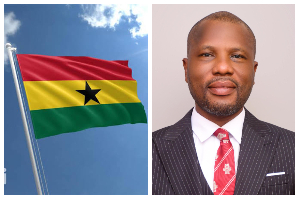
 Professor Dr Dr Frank Yao Gbadago is the author of this article
Introduction
Republicanism is often celebrated through its visible symbols: the flag, anthem, Constitution, Parliament, courts, and elections. Yet, at its deepest philosophical level, a republic is not merely a legal arrangement or a political identity.
Rather, it is a moral covenant between the state and its citizens. It rests on the belief that self-rule must produce the public good, that sovereignty must translate into human dignity, and that citizenship must offer more than formal membership in a nation.
But is this the case for many nations, including our motherland, Ghana? To this end, this paper examines Ghana’s republicanism as a reflection on 66 years of republican status.
The rationale for this reflection lies in the need to interrogate whether Ghana’s republican status has moved beyond constitutional form into developmental substance.
This interrogation is important in assessing the level of national investment, collective effort, strategic direction, resource prioritisation and allocation, as well as the monitoring of national budgets and development priorities in advancing Ghana’s republican promise.
It is also critical in addressing the tension and disconnect between Ghana’s proud republican heritage and the lived realities of many citizens who continue to face unemployment, weak public services, food insecurity, import dependence, inequality, and institutional disappointment.
As a faculty member who participates in many governing board discussions and policy debates across both private and public institutions, I seek to contribute to knowledge and public understanding of the moral covenant required for self-rule to translate into citizen dignity and national self-sufficiency.
The novelty of this reflection lies in shifting the discussion of Republic Day from ceremonial remembrance to developmental accountability.
Rather than asking only whether Ghana is politically independent, the paper asks whether the republic is delivering dignity, productivity, fairness, and self-reliance to its people.
In doing so, it frames Republic Day not merely as a national celebration, but as a philosophical and practical audit of the republic’s promise.
The rest of this paper discusses the symbolic and developmental dimensions of republicanism, Ghana’s republican gains, the unfinished promise of citizen dignity and the collective responsibilities required to build a truly developmental republic.
Republic and Republicanism
A republic is not merely a country with a flag, anthem, Constitution, Parliament, courts, and elections. These are important symbols and structures of statehood, but they are not the full measure of republican success.
The deeper test of republicanism is whether the ordinary citizen can live with dignity: dignity through decent jobs, reliable public services, industrial opportunity, food security, reduced dependence on imports, accountable leadership, and fair access to national resources.
Ghana’s Republic Day should therefore be more than a ceremonial remembrance of constitutional status.
It should be a moment of sober national reflection. We have unquestionably achieved the political form of republicanism. We govern ourselves, elect our leaders, maintain constitutional institutions, and participate in democratic processes.
Yet the question remains: have we converted self-rule into self-reliance? Have we transformed sovereignty into productive capacity? Have we turned democratic governance into accountable development?
Recent experiences from countries such as Malaysia, Russia, the United Kingdom, and the UAE, among others, sharpen this reflection.
These societies are not perfect, but they demonstrate the visible power of organised systems: functioning infrastructure, disciplined public services, efficient transport, relatively predictable institutions, cleaner urban management, stronger service delivery, and clearer alignment between national ambition and public execution.
Such experiences compel the Ghanaian observer to ask: if republicanism is meant to produce dignity, why do many of our citizens still struggle with unemployment, weak public services, poor sanitation, import dependence, food insecurity, institutional inefficiency and uneven access to opportunity?
The concern, therefore, is not whether Ghana is a republic in the formal constitutional sense. That question has long been settled. Ghana possesses the recognised symbols, institutions, and legal architecture of republican statehood.
The more urgent question is whether the republic has matured into a vehicle for broad-based development, citizen dignity, and national self-reliance—that is, whether Ghana is living up to the developmental expectations of republicanism.
This distinction is important because republicanism can exist at two levels. At one level, it is expressed through the visible symbols and structures of statehood: the flag, anthem, Constitution, Parliament, courts, elections, and elected leadership.
At another, more demanding level, it is measured by the quality of life that these institutions produce for the people.
A republic may have all the formal features of self-rule and yet fall short in delivering jobs, reliable public services, industrial capacity, food security, accountable leadership, and fair access to national resources.
It is within this distinction that Ghana’s republican journey must be examined. The country has undoubtedly achieved the outward form of republicanism. The more difficult task is whether it has achieved or is seriously moving toward, the developmental substance of republicanism.
This brings into focus the difference between what may be described as the symbolic republic and the developmental republic.

Copyright © 1994 - 2026 GhanaWeb. All rights reserved.










