



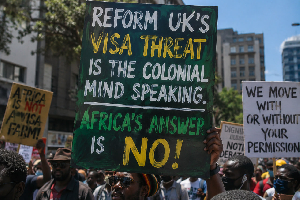
 Reform UK has proposed to restrict visas for nationals from countries pursuing reparations
Let us be direct about what has happened.
A British political party has looked at a continent still carrying the open wound of five centuries of enslavement, kidnapping, colonial extraction, and deliberate underdevelopment, and has decided that the appropriate British response to demands for justice is a threat. Specifically, Reform UK, riding a wave of electoral success in local British elections, has floated the proposal to restrict visas for nationals from countries pursuing reparations for the transatlantic slave trade. Britain, in other words, is threatening to punish people for demanding accountability from Britain.
There is nothing subtle here. There is nothing to decode. This is the colonial mind, undisguised, announcing itself in the language of modern immigration policy instead of the language of plantation law, but carrying the exact same message it has always carried: ‘we will decide what you are owed, and if you disagree, we will make your life more difficult.’
Sir Hilary Beckles, the Chairman of the CARICOM Reparations Commission, named it for what it is. ‘A legacy of toxic racism. A continuation of colonial attitudes. Punishing the victims all over again.’ Beckles has spent his career documenting the economics of slavery in the Caribbean with forensic precision, and he understands better than most that what Reform UK is proposing is not immigration policy. It is intimidation dressed in the language of governance. It is an attempt to use the machinery of the British state, the visa, the border, the right of entry, as a weapon against people whose ancestors built British wealth with their bodies and their blood.
Here is what Comrade Dhoruba Bin Wahad, leader of the Black Panther Party- USA, said when asked directly about exactly this kind of situation. His words need no softening and no editorial translation. Reparations and reparative justice must not be negotiated, especially with former governments that benefited from the sale and marketing of African flesh, but systematically demanded. And his prescription for how that demand should be enforced is as clear as it is powerful. “If Britain wants to secure or purchase African mineral resources, then it can only do so by paying a reparations surcharge or tariff of at least 25 percent. Otherwise, they get nothing.” Furthermore, if England wants to limit visas and immigrant status of Africans in the UK, then African governments should withdraw from the British Commonwealth and impose similar restrictions on British citizens, and expel British business executives of British firms operating in Africa. These firms should either hire African executives or leave.
This is not radicalism for its own sake. This is symmetry. This is the basic principle that a relationship built on mutual interest must actually be mutual. For five hundred years, the terms of engagement between Britain and Africa were set in London, enforced with guns and ships, and sustained through legal systems designed to ensure that only one party in the relationship ever truly benefited. Bin Wahad is simply proposing that Africa use the leverage it actually has, control over its own land, its own minerals, its own markets, to reset those terms on African terms for the first time.
Ghana's role in this moment is worth pausing on, because it is precisely Ghana's moral and institutional leadership on reparations that Reform UK's proposal is attempting to penalise. President John Dramani Mahama, as the African Union's Champion for Reparatory Justice, spearheaded the campaign that led to UN Resolution A/RES/80/250 in March 2026, voted for by 123 member states, declaring the transatlantic enslavement of Africans the gravest crime against humanity. He has said repeatedly that this is not about personal guilt, that no one alive today built the slave ships, but that every generation inherits responsibility for the world that history has created, and that responsibility includes addressing the inequality, poverty, and structural disadvantage that are the direct and documented consequences of enslavement and colonial rule. If Reform UK's response to that moral clarity is a visa restriction, then Reform UK has already told Africa everything it needs to know about whether Britain intends to engage seriously with its own history.
The answer to that answer is not a petition. The answer is economic. And the conditions for that economic answer are better now than they have ever been. The emergence of BRICS, the development of alternative monetary and trade networks not tied to petrodollars, the British pound, or the CFA franc, and the growing confidence of African governments in demanding better terms from all their partners, whether Western, Chinese, or otherwise, have fundamentally changed the geopolitical map. Europe needs African cobalt for its electric vehicles. It needs African lithium for its batteries. It needs African gas as it scrambles away from Russian energy dependency. It needs African agricultural land as climate change destabilises its own food systems. Bin Wahad puts this plainly and correctly: Europe needs Africa. Africa does not need Europe, especially given the alternatives now available.
Reform UK has mistaken an African movement for a request. It is not. The reparations demand is not an appeal for British generosity. It is a civilizational reckoning, backed now by international law, by UN resolutions, by the consensus of 123 governments, by decades of scholarship from some of the finest legal and historical minds on earth, and by the lived reality of billions of people of African descent whose life chances were shaped by a crime that Britain not only committed but systematised, legalised and profited from on a scale that has no parallel in recorded history.
Africa has survived everything the world has thrown at it. It survived the Middle Passage. It survived the plantation. It survived colonialism. It survived the debt trap of structural adjustment. It survived the dismissal of its demands as impractical, emotional, or destabilising. It will survive a Reform UK visa threat without breaking stride. The movement will not stop. It cannot stop, because stopping would mean accepting that the wealth taken was acceptable to keep, that the generations of suffering it caused were an acceptable price, that the inequality still compounding today is simply how things are rather than how they were made to be.
Africa's answer to all of that is no. It was no in 1791 in Haiti when the enslaved rose up and made themselves free. It was no in 1957 when Nkrumah led Ghana to independence and told the world the African revolution had begun. It was no in March 2026 in the United Nations when 123 nations voted together to say that what was done to Africa was the gravest crime against humanity. And it is no today, in the face of Reform UK's threat, said with the full force of a continent that has learned, through five centuries of practice, exactly what it means to fight.

Copyright © 1994 - 2026 GhanaWeb. All rights reserved.










