



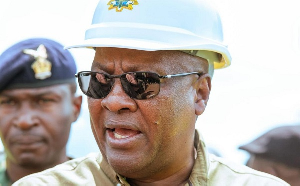
 John Dramani Mahama is the President of Ghana
Dear, H. E John Dramani Mahama.
Congratulations on the commissioning of the National Catheterization Centre at the Korle Bu Teaching Hospital. It is a landmark investment that will strengthen Ghana’s capacity to manage cardiovascular diseases and save countless lives. We also look forward to similar facilities at the Komfo Anokye Teaching Hospital and the Tamale Teaching Hospital as part of a more balanced national health system.
President Mahama, I wish to respectfully draw your attention to another matter that deserves the same sense of urgency. It concerns the daily reality of over 100,000 Ghanaians who travel between Kasoa and Accra.
For many Ghanaians, a full night’s rest of six or more hours remains a normal part of daily life. For many residents within the Kasoa-Accra corridor, however, this has become increasingly difficult to achieve. The long hours spent commuting often begin before dawn and extend late into the evening, reducing the time available for sleep, family, personal development and recovery. The result is a population that arrives at work carrying the invisible burden of exhaustion before the day’s activities even begin.
President Mahama, kindly allow me to present a simple illustration of our reality. Using Ghana’s standard working pattern, an employee who works five days a week, enjoys the statutory minimum annual leave of fifteen (15) working days, and observes public holidays, spends about 232 days commuting to work each year. If that individual spends an average of three (3) hours in traffic every working day, the result is startling.
That person spends approximately 696 hours in traffic every year.
That is 29 full days of life lost in traffic annually.
It is also the equivalent of 87 standard eight-hour working days.
This is time that could have been invested in productive work, family life, education, innovation or rest. When multiplied across the hundreds of thousands of commuters who use the Kasoa corridor each day, the national cost becomes enormous.
President Mahama, I respectfully submit seven (7) reasons why this issue deserves to become a national priority.
1. The Kasoa traffic situation is reducing Ghana’s productive capacity.
Your vision of a 24-hour economy depends on people and businesses making the best use of every available hour. A workforce that spends nearly a month each year trapped in traffic begins every working day already exhausted. Businesses lose valuable labour hours, appointments are delayed, deliveries become unpredictable and the country’s economic output quietly declines.
2. Traffic congestion is undermining the very foundation of the 24-hour economy.
A 24-hour economy requires reliable movement of people, goods and services. When transport corridors become daily bottlenecks, companies face higher operating costs, shift work becomes more difficult to manage and investment decisions are affected. Time is one of the most valuable economic resources. Congestion steadily erodes it.
3. The health consequences eventually become a burden on Ghana’s healthcare system.
Long daily commutes are associated with chronic stress, elevated blood pressure, anxiety, poor sleep, obesity and cardiovascular disease. These are exactly the conditions that require expensive long-term treatment. Every additional patient with hypertension, stroke or heart disease places further pressure on a health system that already operates within limited financial resources.
4. Families are paying an invisible social cost.
Parents leave home before sunrise and return after dark. Children lose meaningful time with their parents. Community participation declines. Family relationships become strained. While these losses rarely appear in economic statistics, they shape the well-being and stability of our society.
5. Businesses are absorbing costs that weaken Ghana’s competitiveness.
Employers lose productive hours through late arrivals, staff fatigue and higher transport costs. Commercial vehicles consume more fuel while stationary in traffic. Vehicle maintenance expenses increase. Supply chains become less efficient. These costs are ultimately transferred to consumers through higher prices.
6. Solving the Kasoa corridor challenge would deliver benefits across multiple sectors simultaneously.
Improving this corridor is an economic reform, a public health intervention, an environmental investment and a social policy. Every minute removed from the daily commute increases productivity, reduces fuel consumption, improves air quality, lowers healthcare costs and gives families more time together.
7. This is an opportunity to define your legacy through measurable improvements in everyday life.
President Dramani Mahama, every government is remembered for projects that people experience daily. For residents of Kasoa and surrounding communities, reducing the daily commute would be one of the most meaningful improvements to their quality of life. Strategic investment in additional transport infrastructure, effective traffic management, expanded public transport, better coordination between national and local authorities, and long-term urban planning would demonstrate that Ghana values the time, health and dignity of its citizens.
President Mahama, we often measure development by the hospitals we build, the roads we construct and the policies we announce. Perhaps we should also measure it by something simpler. How much of a citizen’s life is spent moving freely, and how much is spent waiting in traffic.
The people of Kasoa are hardworking Ghanaians. They contribute significantly to the economy every single day. Their time is a national asset. Protecting it is an investment in productivity, public health and the success of your vision for a stronger and more prosperous Ghana.

Copyright © 1994 - 2026 GhanaWeb. All rights reserved.










