



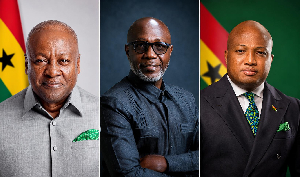
 L-R: President John Mahama, Dr. Kamal Deen Ali and Samuel Okudzeto Ablakwa
Following an earlier analysis of President John Dramani Mahama’s proposal to strengthen maritime connectivity between Tema and Kingston, independent writer and IMANI Centre for Policy & Education Associate, Kay Codjoe, contacted the Ghana Maritime Authority for its perspective on how the directive is being interpreted and implemented.
The Authority responded with a clear emphasis on the commercial and technical work required to move the proposal from presidential intent to sustainable trade. Speaking with Codjoe, Dr. Kamal Deen Ali, Director General of the Ghana Maritime Authority, said the immediate task is to establish the cargo base, understand the markets, examine the available shipping models and determine the economics capable of sustaining stronger maritime links between Ghana and Jamaica.
Dr Ali indicated that the Authority sees the President’s directive as an opportunity to move beyond the political statement made in Kingston and undertake the technical work required to determine what is commercially possible. For the GMA, that means examining existing and potential cargo flows, freight costs, transit times, regulatory requirements and the level of interest among shipping lines before settling on the most appropriate form of connectivity.
President Mahama set the process in motion during his August 2026 visit to Jamaica. After visiting Kingston Port, he drew a comparison with Tema’s development as a maritime hub serving Ghana and the wider Gulf of Guinea and asked what remained to connect the two hubs. He then publicly identified the Foreign Ministers and maritime authorities of both countries as contact points for advancing the proposal.
For Ghana, the directive places Hon. Samuel Okudzeto Ablakwa, Minister for Foreign Affairs, and Dr Ali at the centre of complementary parts of the process. Foreign Affairs provides the diplomatic and government to government channel, while the GMA brings the maritime regulatory, technical and shipping expertise required to examine how the proposed connectivity can support sustainable commerce.
Dr Ali expressed confidence in the collaboration with Hon. Ablakwa in actualising the President’s directive, pointing to the complementary responsibilities of the two institutions. The maritime side can establish what is technically and commercially required, while Foreign Affairs can help advance the diplomatic, bilateral and intergovernmental engagements necessary to move those requirements towards implementation.
That collaboration also begins from an established diplomatic foundation. Ghana and Jamaica already have the Permanent Joint Commission for Cooperation. In May 2026, Hon. Ablakwa and Jamaica’s Minister of Foreign Affairs and Foreign Trade, Senator the Honourable Kamina Johnson Smith, co-chaired its ministerial session in Accra, where trade and investment were among the areas identified for deeper cooperation.
There is already trade on which that work can build. In 2023, Jamaica exported approximately 78.59 million kilograms of aluminium oxide to Ghana worth US$26.35 million. More recently, Jamaica Bauxite Mining Limited disclosed that discussions were underway to revive the longstanding bauxite relationship with Ghana, with an initial business opportunity estimated at about US$60 million.
The existing mineral relationship does not establish the commercial case for a regular Kingston Tema container service. It does, however, show that substantial cargo already moves between the two economies. The next question is whether that relationship can be broadened into more diversified trade.
According to the approach outlined by the GMA, the work requires identifying existing cargo flows, potential additional volumes, freight costs, transit times and the shipping structure best suited to the market. A direct service is one possibility, but feeder connectivity, transhipment arrangements or existing carrier networks could also form part of the eventual model. The commercial evidence will have to determine the option.
That work falls within a wider push by the Authority to improve the competitiveness of Ghana’s ports. In June 2026, the GMA, Ghana Ports and Harbours Authority and other stakeholders began work on a Just In Time sailing project at Tema Port aimed at reducing vessel waiting time, improving turnaround and lowering operating costs. The project is also linked by the Authority to Tema’s designation as a strategic hub for the government’s 24 Hour Economy.
The Kingston proposal therefore intersects with a broader economic objective. A 24 Hour Economy requires more than extended operating hours. Increased production must be supported by logistics and markets capable of absorbing that production. Ports, Customs, warehouses, freight forwarders, transporters and inspection agencies become part of the infrastructure required to move additional goods efficiently.
Ghana recorded about US$5 billion in non traditional exports in 2025, providing a potential export base that includes processed foods, cocoa derivatives, pharmaceuticals, tuna, textiles, shea products and other manufactured and semi processed goods. The commercial task is to identify which products can compete in Jamaica and potentially in wider Caribbean markets.
The proposition also extends beyond bilateral trade. Tema can serve as a platform into West Africa, while Kingston operates within established Caribbean and Americas shipping networks. The concept being examined is therefore not simply Ghana selling to Jamaica. It is whether stronger connectivity between the two ports can support wider regional distribution.
AfCFTA adds another dimension, although Jamaican goods do not automatically receive AfCFTA preferences by entering through Tema, just as Ghanaian goods do not automatically receive CARICOM preferences through Kingston. Any expansion will therefore require attention to tariffs, customs procedures, standards and other regulatory requirements.
The next phase is consequently measurable: the cargo must be identified, the markets established, the shipping model determined and the economics tested.
For the GMA, the presidential directive has moved beyond the statement made in Kingston. The institution now has to work with Foreign Affairs, port authorities, Customs, trade agencies, exporters, freight forwarders, shipping lines and Jamaican counterparts to establish what can be commercially delivered.
The stakes extend beyond creating another maritime route. If stronger connectivity opens new markets for Ghanaian production, improves logistics and expands cargo through Tema, it would also provide a practical link between maritime policy and the 24 Hour Economy. Producing more requires moving more, and moving more ultimately requires markets willing to buy.
Nearly 79 million kilograms of aluminium oxide already provide evidence of meaningful trade between the two economies. The new assignment is to determine what else can move, through which maritime channels and at what commercial advantage.
Kingston opened the conversation. President Mahama issued the directive.
The implementation work has now begun.

Copyright © 1994 - 2026 GhanaWeb. All rights reserved.










