



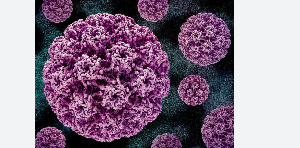
 A photo representing what the cancer cells look like
A Ghanaian scientist is making significant strides in the global fight against cancer, developing cutting-edge fluorescent molecular probes that could dramatically improve early detection and save millions of lives.
Solomon Yamoah Effah, a researcher in physical chemistry, is at the forefront of this breakthrough, using advanced computational methods to design highly sensitive, light-emitting molecules capable of identifying cancer at its earliest and most treatable stages.
Cancer remains one of the world’s deadliest diseases, largely because it is often diagnosed too late. Medical experts consistently emphasize that early detection can push survival rates above 90 percent, while late-stage diagnosis can reduce survival chances to below 30 percent.
Effah’s research, which is available to GhanaWeb, focuses on fluorescent molecular probes — engineered molecules that emit light when they interact with specific biological targets such as DNA mutations or cancer-related biomarkers. These probes act like microscopic sensors, illuminating the presence of disease long before symptoms become severe.
Using computational chemistry, Effah has developed new design principles that significantly enhance the brightness and stability of these probes. His work centers on perylene-modified nucleotides — fluorescent molecules integrated into the building blocks of DNA — which can detect subtle molecular changes associated with cancer development.
Effah’s research has uncovered critical insights that could reshape how fluorescent probes are designed and used in diagnostics:
- Control of fluorescence at the molecular level: His studies show that the angle between a fluorescent tag and DNA determines whether the probe emits light or becomes inactive. Preventing certain molecular alignments preserves brightness, making detection more reliable;
- Optimised probe design: By identifying specific attachment positions on DNA bases that maintain fluorescence, the research provides a roadmap for building more effective diagnostic tools;
- Enhanced stability in biological systems: Findings indicate that natural components of DNA, such as phosphate groups, can help stabilize probes, improving their performance in real-world medical environments;
- Improved molecular linkers: The introduction of specialised linkers reduces signal loss, allowing probes to remain active across a wider range of conditions;
- These discoveries collectively provide a blueprint for developing next-generation diagnostic technologies that are faster, cheaper, and more accurate.
Implications for Global Health
The impact of this work could be transformative, particularly in regions like Ghana and across Africa, where cancer outcomes are often worsened by late diagnosis and limited access to advanced medical equipment.
Traditional diagnostic tools such as MRI and PET-CT scanners are expensive and scarce in many developing countries. In contrast, fluorescent probe-based systems have the potential to be miniaturized into portable, cost-effective devices that can be deployed in district hospitals and rural clinics.
Such technology could enable healthcare workers to detect cancer biomarkers during routine screenings, dramatically improving early diagnosis rates and patient outcomes.
Effah’s computational approach also accelerates the pace of innovation. By predicting how probes will behave before they are physically created, researchers can reduce both the time and cost required to develop new diagnostic tools. This efficiency is particularly crucial for low-resource settings, where affordability determines accessibility.
Beyond detection, the research also hints at future therapeutic applications. Some of the fluorescent molecules studied exhibit properties that could be used in treatment, opening the door to dual-function technologies that both detect and combat disease.
Read his full work, supported by Jonathan Awewomom – Florida International University, Miami, Florida, USA, here
AE

Copyright © 1994 - 2026 GhanaWeb. All rights reserved.










