



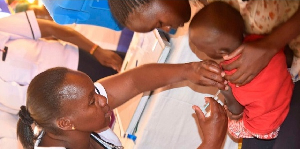
 This file photo shows a child taking a vaccine
Civil society organisations, health officials, and traditional leaders have called on the government to prioritise sustainable financing for Ghana’s immunisation programme to safeguard children and citizens against preventable diseases.
At a Citizens’ Budget Input Forum in Accra, Stephen Atasige, Country Coordinator for the Global Health Advocacy Incubator (GHAI), said the forum provided an avenue for civil society organisations, religious leaders, and traditional authorities to contribute inputs into the 2026 national budget, with particular emphasis on vaccine financing.
The initiative, implemented in partnership with Hope for Future Generations (HFFG) under the Vaccine Advocacy, Sustainability and Networking (VASN) project, seeks to ensure adequate and timely funding for immunisation.
It is also being implemented under the Financing Immunization Advocacy Response (FAIR)Project with the objective to advocate for increased domestic resource mobilisation at the national and subnational level dedicated to Primary Health Care (PHC) and immunisation service delivery.
Atasige commended government for meeting its 2025 vaccine co-financing obligations, amounting to 24.6 million dollars, earlier than in previous years.
“This timely payment is encouraging, but to sustain progress, government must continue prioritising immunisation in future budgets to avoid delays and stock-outs,” he stressed.
He urged stakeholders to explore innovative financing options, including earmarked health taxes and allocations from the National Health Insurance Levy, to build a sustainable pool for immunisation financing.
“By 2030, Ghana is expected to fully finance its immunisation programme without donor support, so we need to prepare now, and ensure that we are capable and independent so that we do not go back to seek donor support ” he added.
Kofi Sarfo Mensah, Principal Planner at the Ministry of Health, who acknowledged the strain on national health financing, assured that government was adopting innovative measures, such as private-public partnerships and efficiency improvements in resource use, to sustain vaccine coverage.
Mensah said the government was taking into consideration, strengthening the local production of vaccines to save purchasing cost as well as locked up of commodities at the port.
He highlighted the role of the National Vaccine Institute, established in 2023, which had advanced efforts in local vaccine production, beginning with an anti-rabies serum.
Cecilia Senoo, Executive Director of HFFG, urged traditional leaders, religious authorities, and civil society to be the “voice of the voiceless” in demanding consistent immunisation funding to protect the health of Ghanaians, particularly children.
Supporting the call, Naana Korleki Korley I, Queen Mother of Ada Terkpebiawe Divisional Area, emphasised that vaccines were an essential commodity for public health, underscoring the empowerment of queen mothers and community leaders in advocating for sustained immunisation.
The forum formed part of broader efforts to ensure that citizen voices influence national budgetary decisions on health financing, particularly immunisation, as Ghana transitions from donor support towards self-sufficiency.
GhanaWeb's latest documentary, Sex for Fish, that explores the plights of teenage girls in coastal communities, all in an attempt to survive, is out. Watch it below:

Copyright © 1994 - 2026 GhanaWeb. All rights reserved.










