



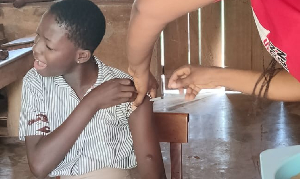
 A girl seen receiving the HPV vacination
Health officials in Yilo Krobo say some parents are stopping their daughters from receiving the free Human Papillomavirus (HPV) vaccine, threatening efforts to protect girls aged nine to 14 years from cervical cancer.
The Yilo Krobo Municipal Health Directorate in the Eastern Region raised the concern during a municipality-wide vaccination campaign, targeting basic and Junior High Schools (JHS) as part of a national effort to prevent HPV infections.
Ms Hannah Danquah, a Municipal Public Health Nurse, during a community engagement organised by the Yilo Krobo Municipal Assembly, said the resistance became evident when some girls refused the vaccine, citing parental instructions.
“When we probed further, the girls said their parents cautioned them not to take the vaccines,” she said.
She stated that while some parents cited peculiar illness as a reason for their rejection of the vaccine, others gave no clear justification.
She said the Directorate aimed to vaccinate over 8,000 girls in the municipality, but about 2,000 received the vaccine on the first day, and indicated that, though the number of resistant parents was relatively small, officials are worried that the number was significant enough to raise concern.
Ms Danquah said health workers had tried engaging parents to explain the vaccine’s safety and importance, but some remain unconvinced.
“We want to cover all children from ages nine to 14 years. We are trying to address it by engaging school heads to continue to educate parents to allow us to vaccinate the children,” she said.
She emphasised that the HPV vaccine was safe, free, and globally approved, having been tested in several countries and proven effective in preventing HPV infections, the leading cause of cervical cancer and genital warts.
“If we don’t vaccinate our children, especially those from nine to 14 years, we fear that when they begin sexual activity in a few years, they will be exposed to the HPV virus,” she cautioned.
Ms Danquah also stressed the importance of early detection and prevention of cervical cancer, noting that women should ideally be screened at ages 21, 35, and 45.
However, many women do not undergo regular screening and often detect the disease too late.
“If the girls are not vaccinated and later get exposed to the HPV virus, they could suffer from serious health complications, including conditions that may require the removal of the uterus,” she warned.
She urged parents to trust the health system and cooperate with health officials to ensure their daughters were protected.
“The vaccines are reliable, safe, and effective. They have been tested and proven to work,” she said.
The Directorate reaffirmed its commitment to achieving full coverage of the HPV vaccination campaign in the municipality and believed that continuous public education and community engagement with parents, school authorities, and opinion leaders were crucial to increasing vaccine acceptance.
Meanwhile, health officials are intensifying community sensitisation efforts to dispel myths and misinformation surrounding vaccination.
Vaccine hesitancy remains a persistent challenge in parts of the Krobo area.
During the COVID-19 vaccination campaign, some residents of Upper Manya Krobo reportedly refused the jab due to unfounded myths.

Copyright © 1994 - 2026 GhanaWeb. All rights reserved.










