



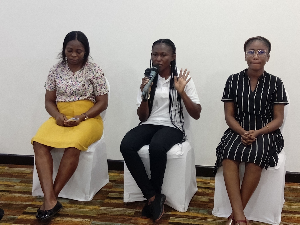
 Some of the survivors speaking at the two-day training programme
Some survivors of tuberculosis (TB) have shared painful personal experiences of loss, discrimination, and financial hardships, calling for stronger social support systems, improved public education, and an end to the stigma that continues to surround the disease.
The survivors spoke at a two-day training programme on Drug-Resistant Tuberculosis (DR-TB) organised by the Ghana National TB Voice Network (GNTBVN) in Accra.
The event brought together TB survivors, health workers and journalists as part of a nine-month DR-TB project funded by the Challenge Facility for Civil Society 2025 and implemented in the Ashanti, Eastern, Greater Accra, and Central regions.
For many of the survivors, the disease went beyond physical illness, disrupting families, livelihoods, and social relationships.
A 47-year-old TB survivor, Lawrence Hebidzi, a resident of Kofi Kwei in Accra, recounted how the disease slowly took control of his life after he began losing weight and appetite.
Unaware of what TB was, he said he delayed seeking care until his condition worsened.
“I contracted TB in 2023. I don't know how it happened, but after six weeks of persistent coughs, it became serious, and I reported to the hospital,” he said.
Hebidzi explained that he underwent multiple treatment phases spanning more than a year before finally recovering.
During that time, he lost his ability to work as a mason and carpenter, his marriage broke down, and his family structure collapsed.
“My wife left me, and my 13-year-old daughter got pregnant, all because I lost control of my family. I lost hope at a point,” he said.
Now fully recovered, he encouraged TB patients to adhere strictly to treatment and appealed to the government to subsidise food for patients.
According to him, the requirement to eat heavily during treatment places a heavy financial burden on patients who are often too weak to work.
Another survivor, Adei Frimpong, a facilitator at a private school in the Ashanti Region, described her experience as one marked by emotional trauma and social rejection.
Diagnosed initially with pneumonia before being confirmed as TB, she was transferred to the Komfo Anokye Teaching Hospital for treatment while five months pregnant.
“The pregnancy was terminated so I could take the medication. Losing a pregnancy was not easy, and the stigma made it worse,” she stated.
Although her parents supported her, she was asked to resign from her job and faced rejection from her husband, who refused to take a TB test.
The marriage eventually collapsed.
Frimpong said her prior knowledge of TB helped her maintain a positive mindset during treatment, but stressed that stigma remains a major barrier to care.
“Stigmatisation is real. If patients are stigmatised, they will not seek treatment,” she warned, urging stakeholders to prioritise public education.
Bridgette Abaidoo, who contracted TB at the age of 14 in 2014, shared how the disease derailed her education and isolated her socially.
She suffered severe coughing, asthma attacks, and loss of mobility, and was on medication for 18 months, and was forced to write her Basic Education Certificate Examination from the hospital.
Fully recovered, the 26-year-old survivor now lives with one lung, after the disease caused irreversible damage to the other—a loss she says has permanently changed her life.
“The community said I was HIV positive. People stopped buying from my parents, and I lost friends,” she said, adding that only her family stood by her.
Now at the university, Bridgette called on the government and partners to invest more in TB prevention and survivor support, stressing that TB is curable and not a death sentence.
The survivors also spoke about lingering effects after treatment, including physical weakness, psychological trauma, and continued discrimination, sometimes even within health facilities.
A Physician Specialist at the Greater Accra Regional Hospital, Dr Woedem Tettey, who participated in the programme, said the testimonies highlight the urgent need for early detection, proper use of protective equipment by health workers, and stronger social interventions.
She noted that ignorance fuels fear and stigma, worsening the burden on patients.
The training programme aimed to amplify survivor voices, build understanding of DR-TB and encourage responsible reporting, with organisers stressing that addressing stigma, financial hardship and delayed diagnosis is critical to eliminating TB in Ghana.

Copyright © 1994 - 2026 GhanaWeb. All rights reserved.










