



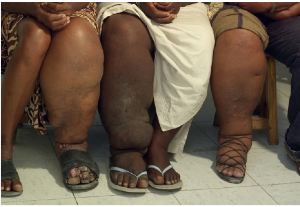
 Photo of people with elephantiasis
More than 300 persons in the Wenchi Municipality of the Bono region have been infected with elephantiasis, Dr Vera Serwaa Opoku, Postdoctoral fellow at the Kumasi Center for Collaborative Research (KCCR) has said.
She said the results of 328 out of 4,954 persons tested in a clinical screening exercise conducted in the municipality confirmed positive, saying that the center had already administered drugs to the infected persons.
Dr Opoku disclosed the outcome of the screening exercise in an interview with the media on the sidelines of a meeting of the Wenchi Municipal Directorate of Health at Wenchi and added that the screening was conducted within six months in 2025.
She said that with the drugs, the infected persons could be treated; however added that their treatment process would take about two years from the day they took the medication.
Dr Opoku urged everybody to protect him/herself from mosquito bites and always clear their weedy surroundings and desilt choked gutters.
She explained that infected mosquitoes transmitted elephantiasis to humans through bites, and urged the people to keep their surroundings clean and observe personal hygiene too.
She also urged the people to take precautionary measures by sleeping under insecticide-treated nets, saying that the vectors were always active in the evenings and early morning hours.
Dr Opoku said infected mosquitoes thrived around water basins and open gutters as well as bushy environments and waterways, and advised the people in those areas who experienced unusual abnormalities to visit the nearest health facilities for a medical checkup.
She said with early diagnosis and detection, elephantiasis could easily be managed and treated, explaining that elephantiasis, also known as lymphatic filariasis, was a neglected tropical disease caused by parasitic worms transmitted through mosquito bites.
It causes severe, permanent swelling (lymphedema), skin thickening, and hardening, usually in the legs, arms, or genitals.
The infection often causes physical disability, pain, and societal stigmatization in tropical regions.
Mahama, Veep share laughs after Minority presents cocoa pods in Parliament

Copyright © 1994 - 2026 GhanaWeb. All rights reserved.










