



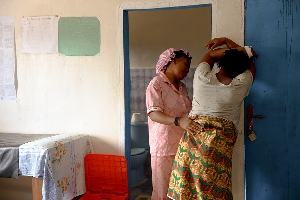
 These figures are not abstract as they represent the conditions facing Ghanaian mothers every day
A chronic lack of clean water and hygiene services in delivery rooms is contributing to maternal sepsis in one in nine births in Africa, with around 13,000 women dying from maternal sepsis each year, new research from WaterAid reveals.
That is equivalent to 36 mothers lost every day, making women in Sub-Saharan Africa 144 times more likely to die from sepsis than those in Western Europe and North America, WaterAid's new "Born without water" report reveals.
The new research exposes the shocking reality inside some of the world's most under-resourced maternity wards and reveals stark global inequalities in maternal sepsis, a life-threatening infection linked to unhygienic childbirth conditions and the third leading cause of maternal mortality worldwide.
Deep diving into the state of maternity wards across 10 Sub-Saharan African countries, the research finds that 76% of births — around 3 in 4 — occur in "unsafe" delivery rooms, defined by the lack of basic essentials: 65% of births take place in facilities which lack proper cleaning, 66% are without handwashing facilities and soap, and 78% without any decent toilets.
This means mothers are often giving birth in blood-stained rooms and forced to walk to unclean rivers to wash with open wounds post-birth, while babies are delivered by healthcare workers and midwives who have no choice but to provide care with unclean hands and equipment.
Global aid cuts are stalling — or even reversing — progress in reducing maternal and infant deaths. Yet simple, affordable essentials like clean water, toilets, and handwashing could cut maternal infections and deaths by at least 50%, WaterAid reveals.
The report finds that investing in and delivering universal WASH across healthcare facilities could prevent 10 million cases of maternal sepsis and 8,580 deaths worldwide every year — at a cost of less than $1 per person, much cheaper than the cost of treating sepsis.
In Ghana, the data paints an equally sobering picture.
According to WaterAid's 2025 figures, 98% of health centre births in the country took place without basic sanitation — a near-total absence of one of the most fundamental requirements for safe childbirth. One in three births (33%) occurred without a basic water service, while 43% lacked access to handwashing facilities, 59% had no environmental cleaning, and 69% lacked safe waste management.
These figures are not abstract. They represent the conditions facing Ghanaian mothers every day — conditions that Ghana, as a signatory to global WASH commitments, has both the obligation and the means to change.
Ewurabena Yanyi-Akofur, Country Director, WaterAid Ghana, said:
“When 98% of births in Ghanaian health facilities happen without basic sanitation, this is not a statistic — it is a daily risk to mothers and newborns. Women are giving birth without clean water, safe toilets, or the hygiene needed to prevent infection. These are not luxuries. They are the minimum for safe motherhood — and Ghana’s mothers deserve better.
For over 40 years, WaterAid Ghana has shown that change is possible. The policies exist. The commitments have been made. What is missing is delivery. The Time to Deliver Campaign is a call to turn promises into action — funded, measurable, and immediate. The time to deliver is now”
This research marks the launch of WaterAid's global Time to Deliver campaign, bringing together sixteen countries in a collective call for urgent action on maternal health. By putting women's voices and demands at its centre, the campaign calls on governments and global institutions to meet their commitments and invest in clean water, safe sanitation and hygiene services — fundamental systems that underpin safe pregnancy and childbirth worldwide.
Meanwhile, WaterAid is calling on people to show their support for the campaign by signing a global petition to world leaders, ahead of the UN Water Conference in December.

Copyright © 1994 - 2026 GhanaWeb. All rights reserved.










