



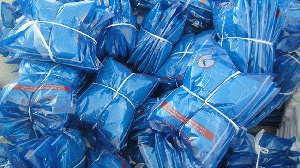
 File photo of insecticide-treated nets
The Ghana Health Service (GHS) has debunked claims circulating on social media that insecticide-treated nets being distributed to school pupils contain harmful chemicals that pose a danger to health.
This was contained in a statement issued by the Service on June 26, 2026.
"The attention of the Ghana Health Service has been drawn to a video circulating on social media purporting that the insecticide-treated nets (ITNs) currently being distributed to primary school children contain dangerous chemical compounds that are harmful to human health.
"We wish to state categorically that these claims are false, misleading, and without any scientific or regulatory basis," it stated.
The Service explained that the nets have been approved by the World Health Organisation and are safe for use.
"The net being distributed by the Ghana Health Service is the Interceptor® G2, a WHO-approved Long-Lasting Insecticidal Net manufactured to international standards and selected as part of Ghana's national malaria elimination effort", the statement said.
According to the GHS, the nets contain two insecticidal compounds, "chlorfenapyr and "alpha-cypermethrin, both of which have been used in public health programmes around the world for many years".
Addressing specific claims about respiratory risks, the Service explained that the compounds in the net have an extremely low vapour pressure, meaning they do not become airborne as dust, smoke, or aerosol.
As a result, a person sleeping under the net breathes normal air, not insecticide.
The GHS noted that over decades of ITN use across sub-Saharan Africa, there has not been a single documented case of respiratory illness linked to proper use of these nets.
"Insecticide-treated nets have been used across Ghana and sub-Saharan Africa for several decades, and across all that time, not one documented case of respiratory illness has ever been linked to sleeping under a properly used insecticide-treated net," it stated.
The Ghana Health Service appealed to parents, caregivers and communities to continue using the nets to protect children against malaria, which remains one of the leading causes of illness and death among children in Ghana.
It advised users to air newly received nets in a shaded, well-ventilated area for up to 48 hours before first use to allow any mild odour from the packaging to dissipate.
Don't use mosquito nets as trap doors and window nets
The Service also cautioned the public against spreading unverified health information online.
"Refrain from sharing unverified health claims. Misinformation causes unnecessary fear and puts children and everyone at risk," the statement said.
The GHS encouraged members of the public who have concerns or experience unusual reactions after using the nets to report to the nearest health facility for medical advice.
See the full statement below:
❗️PRESS RELEASE❗️
— Ghana Health Service (@_GHSofficial) June 26, 2026
GHS CLARIFIES SAFETY OF INSECTICIDE-TREATED NETS DISTRIBUTED TO PRIMARY SCHOOL CHILDREN pic.twitter.com/iGFI0XxVo4
Adwoa Safo is in critical condition and needs prayers– Family appeals

Copyright © 1994 - 2026 GhanaWeb. All rights reserved.










