



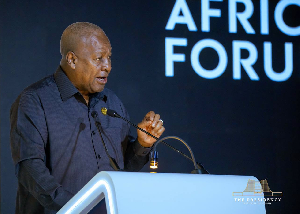
 President John Dramani Mahama
Addressing a high-level audience at the Alamein Africa Forum in Egypt on Saturday, President John Dramani Mahama issued a direct challenge to key actors across the continent’s economic landscape, demanding concrete mechanisms to transition Africa from health dependency to self-reliance.
Speaking in the historic coastal city of El Alamein, once a strategic battleground during the Second World War and now a modern symbol of economic transformation, President Mahama insisted that health must no longer be treated as a charitable cause or a secondary budget expenditure, but as an investable, high-growth economic sector.
Putting panel members and industry leaders on the spot immediately after his keynote address, the President posed three pivotal questions aimed at addressing the systemic bottlenecks hindering local pharmaceutical production:
To financiers: “What specific de-risking instruments and blended finance structures do you need from governments to deploy patient capital into African pharmaceutical plants today?”
To regulators: “How quickly can we operationalise the African Medicines Agency to ensure a single drug approval opens the doors to all 54 AU member states?”
To industrialists: “What strategic partnerships do we need to move from basic packaging and fill-and-finish operations to full Active Pharmaceutical Ingredient (API) synthesis on African soil?”
President Mahama’s call comes against the backdrop of significant macroeconomic and healthcare vulnerabilities. Africa currently imports more than 70 per cent of its pharmaceuticals and an overwhelming 99 per cent of its vaccines, resulting in billions of dollars in foreign exchange outflows each year.
The situation is compounded by projections from the Organisation for Economic Co-operation and Development (OECD), which indicate that traditional donor health assistance to Africa could decline by 29 to 46 per cent compared with 2024 levels.
Reframing the shrinking aid landscape as a potential commercial opportunity, President Mahama cited economic data to support his position. Pointing to the Copenhagen Consensus, he noted that every dollar invested in basic maternal and newborn care yields $87 in economic and social returns.
Data from the Lancet Commission, he added, show that reductions in mortality accounted for nearly a quarter of income growth in developing countries during the early 2000s.
To address regulatory fragmentation and market access challenges, President Mahama announced the introduction of HINGE (Health Investment and National Gateway Enabler). Developed collaboratively by the African Medicines Agency (AMA), Institut Pasteur and AfroChampions, the digital platform aims to streamline regulation, clinical validation and commercialisation across borders through a unified process.
President Mahama noted that the Accra Reset Presidential Council, which he chairs, is deploying dedicated task forces and a Reform Interlock Observatory to track continental capital flows and dismantle non-tariff barriers across regional value chains.
Highlighting successful continental models, the President pointed to Egypt’s reduction of Hepatitis C prevalence from 10 per cent to below 0.5 per cent by prioritising local production, technology transfer and domestic pharmaceutical champions such as Pharco over expensive imported therapies.
He also praised Nigeria’s African Medical Centre of Excellence (AMCE) in Abuja for helping to address the estimated $6 billion lost annually to outbound medical tourism.
“Let us stop treating health as a line-item expense,” President Mahama urged the delegates.

Copyright © 1994 - 2026 GhanaWeb. All rights reserved.










