



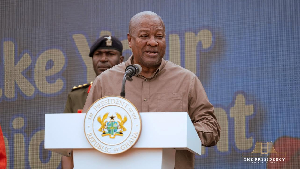
 President John Dramani Mahama
The United States government is pushing to reopen talks with Ghana to amend or strike controversial clauses in a heavily criticised $109 million health financing compact previously rejected by Cabinet.
Drafted as a replacement for previous health sector contributions channelled through the United States Agency for International Development (USAID), the agreement hit a brick wall after Ghanaian authorities scrutinised the text and flagged specific terms as demeaning and potentially infringing on national sovereignty.
Addressing a town hall gathering in Goaso, Ahafo Region, President John Dramani Mahama said Washington had initiated contact to review the package, signalling that dialogue remains very much alive.
“I have already spoken about the health funding deal sought by the U.S. The latest is that they have reached out to review the deal, and there is room for further discussions,” he noted.
Emphasising the administration's stance, the President underscored that Ghana would hold its ground on safeguarding its sovereignty as fresh deliberations concerning the financial arrangement unfold.
Vehicle Preaching Not Banned, Mahama Clarifies Amid Public Uproar
President John Dramani Mahama has moved to quell widespread public anxiety, insisting that the state has not banned preaching aboard commercial transport and framing the contested provisions under the Road Traffic Regulations, 2026 (L.I. 2519) as a purely safety-driven measure.
Addressing the controversy for the first time since backlash erupted over Regulation 141 of the legislation, the President explained that unmonitored activities inside transit vehicles pose serious distractions that jeopardize the lives of drivers, commuters, itinerant preachers, and traders alike.
“It has come to my attention that there is a perception that we have banned preaching in vehicles. What we are saying is that no one should preach or sell in a moving vehicle. Regardless of your faith, you cannot preach in a moving vehicle, but you can preach when the vehicle is stationary. It is not true that we have banned preaching in vehicles,” he clarified.
Under the disputed framework, both commercial preachers and hawkers are barred from plying their activities while vehicles are in motion, with breaches carrying penalties ranging from 10 to 50 penalty units, a jail term of up to eight months, or a combination of both.
The regulations quickly drew sharp condemnation from various religious groups and citizens who questioned the potential constraints on religious expression and grassroots evangelism.
In response to the mounting public friction, the administration has initiated broader consultations to review the directive. Concurrently, the state has put the enforcement of the controversial subsection on hold pending further deliberation.

Copyright © 1994 - 2026 GhanaWeb. All rights reserved.










