


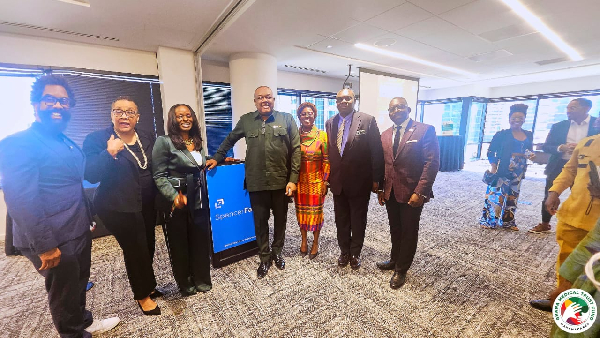
 Some of the stakeholders at the event
The Ghana Medical Trust Fund (GMTF) has called on American hospitals, healthcare investors, medical schools, foundations and philanthropists to forge strategic partnerships with Ghana to expand access to specialised healthcare, particularly for patients battling cancer and other chronic diseases.
The Administrator of the Fund, Adjoa Obuobia Darko-Opoku, made the appeal at the Ghana-Tennessee Business and Investor Roundtable in Nashville, Tennessee, where she highlighted the Fund's achievements and outlined opportunities for US-based institutions to contribute to Ghana's healthcare transformation.
She said strategic partnerships with American institutions could help bridge critical gaps in cancer treatment, medical diagnostics, specialist training and healthcare infrastructure while easing the financial burden on patients and their families.
"For many families, a diagnosis is difficult enough. But the next question is often even more frightening: how are we going to afford the treatment, and where can we access this care?" she said.
Darko-Opoku explained that the Fund was established to provide financial assistance for specialised medical treatment, strengthen healthcare infrastructure, build specialist capacity and support research into chronic diseases.
She disclosed that more than 800 patients had been enrolled for treatment under the Fund's services package, which covers 13 common cancers in Ghana, as well as neurosurgical conditions, cardiovascular diseases and kidney-related illnesses.
Highlighting the Fund's achievements, Darko-Opoku said GMTF had reconstructed the cardiac catheterisation laboratory at Korle Bu Teaching Hospital following a fire that disrupted critical services.
The facility, commissioned by President John Dramani Mahama, has since supported more than 160 procedures, including interventions involving 110 children, restoring access to essential cardiac care.
She said the Fund was also supporting the expansion of cancer treatment services through the construction of oncology centres at Komfo Anokye Teaching Hospital in Kumasi and Tamale Teaching Hospital.
In partnership with the KGL Group, GMTF is pursuing a proposed US$10 million diagnostic and imaging centre at Ridge Hospital to improve access to critical diagnostic services, including magnetic resonance imaging (MRI), computed tomography (CT) scans and mammography.
Darko-Opoku further announced plans to establish an advanced comprehensive oncology centre at Korle Bu Teaching Hospital to ease pressure on existing cancer treatment facilities, reduce waiting times and improve access to specialised care.
The Fund is also investing nearly GH¢1 billion in retooling major hospitals with essential medical equipment, including dialysis machines, intensive care unit beds, oxygen concentrators and patient monitors.
To address shortages of specialised healthcare professionals, GMTF is sponsoring the training of 100 specialist pharmacists and 100 specialist nurses, while supporting the establishment of specialist medical training centres in six regions.
Its digital platform, GMTF Care, is also facilitating patient enrolment across participating health facilities to improve access to the Fund's services.
Darko-Opoku identified five key areas in which American institutions could partner with the Fund: healthcare infrastructure development; medical equipment and technology; specialist training and clinical exchanges; research and innovation; and financial assistance for vulnerable patients.
She said GMTF was particularly interested in collaborations that would improve access to advanced cancer diagnostics and treatment, create specialist fellowship opportunities for Ghanaian healthcare professionals, equip hospitals with modern medical technology and promote joint research into chronic disease prevention and management.
The Fund is also exploring the expansion of its treatment package to include additional services, such as kidney transplantation, while strengthening specialist capacity in oncology, cardiovascular medicine and urology.
Darko-Opoku acknowledged that Ghana's growing demand for specialised healthcare required substantial investment and sustained collaboration beyond what government resources alone could provide.
She therefore urged American healthcare institutions, investors and philanthropic organisations to consider Ghana a strategic partner in efforts to improve healthcare delivery and expand access to life-saving treatment.
Making a direct appeal to participants at the roundtable, Darko-Opoku called on American hospitals, universities, foundations, investors and members of the Ghanaian diaspora to move beyond expressions of goodwill and commit to practical, results-oriented partnerships.
She encouraged interested organisations to engage GMTF in discussions aimed at identifying priority projects, determining the technical or financial support required and developing implementation plans with clearly defined outcomes.
According to her, such partnerships could involve equipping hospitals with advanced diagnostic technology, establishing specialist training and clinical exchange programmes, investing in cancer treatment infrastructure, supporting medical research or financing treatment for patients who cannot afford specialised care.
"We are open to partnerships that bring together investment, technical expertise and a shared commitment to results," she said.
The Administrator emphasised that meaningful international collaboration would not only improve healthcare infrastructure but also strengthen Ghana's specialist medical workforce and help ensure that access to life-saving treatment was not determined by a patient's financial circumstances or geographical location.
She urged interested American institutions and individuals to initiate discussions with the Fund following the Nashville engagement to identify areas of mutual interest and develop concrete proposals for collaboration.
"What we have achieved so far shows what is possible. With the right partnerships, we can do much more," she said.
Darko-Opoku reaffirmed the Fund's commitment to building a more accessible, equitable and sustainable specialised healthcare system through strategic investment, institutional partnerships and continuous improvements in healthcare delivery.
She stressed that collaboration with American healthcare institutions and investors could accelerate the development of critical medical infrastructure, enhance knowledge transfer and expand treatment opportunities for thousands of Ghanaians living with cancer and other chronic conditions.
The Nashville engagement, she indicated, offered a platform for translating international interest in Ghana's healthcare sector into tangible investments and partnerships capable of delivering lasting benefits to patients and the country's health system.
The Fund's appeal underscores the growing importance of international cooperation in addressing Ghana's specialised healthcare challenges and ensuring that more patients, regardless of income or location, can access the treatment they need.

Copyright © 1994 - 2026 GhanaWeb. All rights reserved.










