


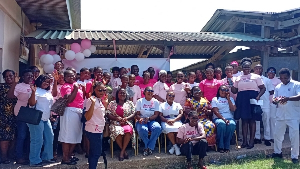
 Some facilitators and participants of the breast cancer awareness and screening programme in a photo
The Head of Surgical Sub-BMC at the Ho Teaching Hospital, Dr Nelson Kosi Affram, has urged men and women to examine their breasts regularly and seek medical attention promptly when they notice unusual changes to improve the chances of early breast cancer detection and treatment.
He cautioned against waiting for symptoms to develop before visiting a health facility, explaining that breast cancer could begin without noticeable signs.
Dr Affram made the statement during a breast cancer awareness and screening programme organised by the Ho Teaching Hospital in collaboration with the LoveAid Foundation and the Women of Impact Community.
He encouraged people to become familiar with their breasts through monthly self-examinations and seek professional assessment at regular intervals.
“You don’t have to wait until something happens to your breast before you come, because actually when breast cancer starts, you will not feel anything,” he said.
He recommended annual mammography for people aged 35 years and above who could afford it, describing the procedure as the gold standard for detecting breast lesions.
The general surgeon also advised people to visit health facilities for clinical breast examinations, noting that further investigations, including ultrasound scans, could be conducted when abnormalities were suspected.
He stressed that not every lump or change in the breast is cancer, but urged the public to take unusual changes seriously and avoid delays in seeking medical care.
According to him, late presentation remains a major challenge in the fight against breast cancer, contributing to increasing deaths associated with the disease.
He identified patient-related delays, delays by healthcare practitioners and health system challenges, including inadequate diagnostic equipment, as factors affecting timely diagnosis and treatment.
Dr Affram advised menstruating women to examine their breasts about 5 days after their period each month, while post-menopausal women could choose a fixed day for the exercise.
He explained that self-examination is about knowing what is normal and recognising changes that might require medical attention.
The Executive Director of the LoveAid Foundation, Princess Lovia Tetteh, in her address called for sustained community education and support for patients and survivors, urging the public to confront fear, stigma and misinformation surrounding the disease.
She said breast cancer awareness must go beyond wearing pink and organising annual programmes to promote practical action, including early screening, timely medical intervention and compassionate support for affected persons.
“Awareness must become knowledge. Knowledge must become action. And action must create a better chance of survival,” she said.
Ms Tetteh noted that fear of diagnosis, misconceptions and reliance on unverified remedies often cause people to delay seeking professional care.
She urged communities to approach these challenges with empathy and ensure that patients could access accurate information and healthcare without being judged or stigmatised.
She also called for improved access to breast cancer assessment, diagnosis, treatment and psychosocial support, stressing that awareness without access to healthcare left patients vulnerable.
Ms Tetteh encouraged men to take an active role in breast cancer awareness by supporting women to seek medical attention, accompanying them to appointments and helping reduce the emotional and financial barriers to care.
She further urged communities to sustain awareness through workplace programmes, school-based education and community outreach, while ensuring that survivors and patients received dignity and support.
Participants were also educated on the Mahama Cares programme, which provides support for cancer patients among other conditions through four key areas: patient bills, infrastructure and equipment, specialised personnel training and research.
The programme is intended to ease the financial burden on patients while strengthening the healthcare system’s capacity to provide cancer services.
Participants were informed that the fund supports the payment of patients’ medical bills, provides equipment and infrastructure needed for diagnosis and treatment, trains specialised healthcare personnel and supports research into improved treatment methods.

Copyright © 1994 - 2026 GhanaWeb. All rights reserved.










