


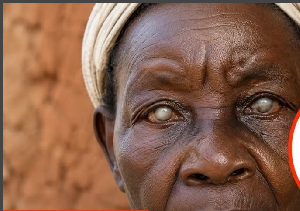
 Photo of a woman with river blindness condition
The Eastern Regional Health Directorate is targeting 134,774 people for the second round of the 2026 Mass Drug Administration (MDA) exercise against onchocerciasis, commonly known as river blindness.
The exercise, scheduled for November 15 to 28, 2026, will cover four districts in the Eastern Region: Kwahu East, Kwahu Afram Plains North, Kwahu Afram Plains South and Ayensuano.
According to the Eastern Regional Health Directorate, the region has an estimated at-risk population of 168,467 people, with 19 at-risk sub-districts and 366 communities expected to benefit from the intervention.
The nationwide exercise will cover 15 regions and 86 participating districts, targeting approximately 6.3 million people living in communities affected by the disease.
The distribution of ivermectin tablets will be carried out through a house-to-house approach, with trained health workers and Community-based Drug Distributors (CDDs) visiting homes to administer the medication to eligible residents.
Onchocerciasis, also known as river blindness, is a parasitic disease caused by Onchocerca volvulus and transmitted through the bites of infected blackflies that breed around fast-flowing rivers.
The disease can cause intense itching, skin changes, including a condition known as leopard skin, and blindness. It is also identified as the second-leading cause of avoidable blindness globally.
The Directorate explained that Mass Drug Administration remains the main strategy for eliminating the disease, alongside health education and community sensitisation.
The Eastern Regional Health Directorate is targeting 134,774 people for the second round of the 2026 Mass Drug Administration (MDA) exercise against onchocerciasis, commonly known as river blindness.
Discover more
Starr FM merchandise
Buy Maps
Explore History
The exercise, scheduled for November 15 to 28, 2026, will cover four districts in the Eastern Region: Kwahu East, Kwahu Afram Plains North, Kwahu Afram Plains South and Ayensuano.
According to the Eastern Regional Health Directorate, the region has an estimated at-risk population of 168,467 people, with 19 at-risk sub-districts and 366 communities expected to benefit from the intervention.
The nationwide exercise will cover 15 regions and 86 participating districts, targeting approximately 6.3 million people living in communities affected by the disease.
The distribution of ivermectin tablets will be carried out through a house-to-house approach, with trained health workers and Community-based Drug Distributors (CDDs) visiting homes to administer the medication to eligible residents.
Discover more
News subscription service
Election coverage updates
Global news analysis
Onchocerciasis, also known as river blindness, is a parasitic disease caused by Onchocerca volvulus and transmitted through the bites of infected blackflies that breed around fast-flowing rivers.
The disease can cause intense itching, skin changes, including a condition known as leopard skin, and blindness. It is also identified as the second-leading cause of avoidable blindness globally.
The Directorate explained that Mass Drug Administration remains the main strategy for eliminating the disease, alongside health education and community sensitisation.
Discover more
Shop African Art
Health
health
However, pregnant women, children below 90 centimetres in height, mothers breastfeeding babies less than one week old, and seriously ill persons are excluded from receiving the medication.
Eligible residents are being encouraged to take the ivermectin tablets immediately as directed by trained distributors.
The public has also been advised to report any adverse drug reactions to community drug distributors or the nearest health facility.
Addressing the media, the Deputy Eastern Regional Health Director Dr.Moses Barimah Djimatey called on District Assemblies, Assembly Members, traditional and religious leaders, and other opinion leaders to support public education and mobilisation to ensure maximum participation.
He stressed that the participation of eligible community members in the second round of the intervention is critical to preventing avoidable blindness and achieving the elimination of river blindness in affected communities.

Copyright © 1994 - 2026 GhanaWeb. All rights reserved.










