



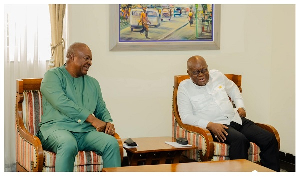
 President John Dramani Mahama (L) with former President Nana Addo Dankwa Akufo-Addo
The recently announced 9 percent increase in the 2026 Base Pay on the Single Spine Salary Structure has sparked discussions among public sector workers and labour analysts, as historical data show it is the lowest salary increment in nearly a decade.
According to the agreement signed on November 9, 2025, between the Government of Ghana and Organised Labour, the new base pay adjustment takes effect from January to December 2026. While the government described the deal as fair and reflective of current economic conditions, a review of salary trends from 2017 to 2024 shows a significant decline in the rate of public sector pay growth compared with previous years.
Data compiled from the Fair Wages and Salaries Commission (FWSC) indicate that under the New Patriotic Party (NPP) administration between 2017 and 2024, salary increments for public sector workers were consistently higher.
For instance:
In 2017, salaries rose by 12.5%.
In 2018, by 11%.
In 2019, by 10%.
In 2020, by 15%.
In 2021, workers received 4% plus a 15% interim premium.
In 2022, a 15% Cost of Living Allowance (COLA) was applied to the base salary.
In 2023, public sector workers enjoyed a 30% increment — one of the highest in the NPP era.
And in 2024, increments were 23% for the first half of the year and 25% for the second half.
Government approves 9% salary increase for public sector workers
In contrast, the new 9% increase for 2026 represents a sharp decline, falling below even the lowest adjustments recorded under the NPP administration.
Labour experts note that while the government faces fiscal constraints and seeks to maintain economic stability under the current IMF-supported programme, the modest increase could weaken workers’ purchasing power amid persistent inflation and cost-of-living pressures.
Some labour leaders have also expressed concern that the 9% adjustment does not adequately reflect the sacrifices of public sector employees or the rising cost of living.
Government representatives, however, have defended the agreement, saying it is part of broader efforts to maintain wage sustainability and protect jobs while continuing engagements with labour on other outstanding conditions of service.
The 2026 Base Pay Agreement, signed by the Fair Wages and Salaries Commission (FWSC) and the Trades Union Congress (TUC), marks the first major wage negotiation under the new administration — but one that already sets a markedly different tone from the more generous salary adjustments of recent years.
Watch the promo to GhanaWeb's latest documentary, which uncovers the evolution of ‘kayamata,' an exploitative practice fueled by love charms and manipulation, titled, “The Dark Side of Kayamata,' below:
RTI filed over Bryan Acheampong’s controversial US army service claim
The wait is over! The GhanaWeb Excellence Awards 2025 is officially launched. Let's celebrate impact, innovation and excellence across Ghana.
Who deserves to be honoured this year?
Nominate now 👉 https://ghanaweb.com/ghanaexcellenceawards/nominate

Copyright © 1994 - 2026 GhanaWeb. All rights reserved.










