



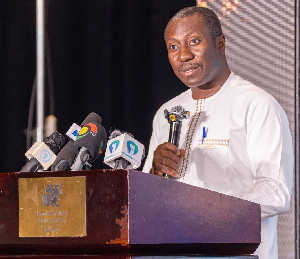
 Minority Leader Alexander Afenyo-Markin
Minority Leader Alexander Afenyo-Markin has challenged journalists to intensify investigative reporting into Ghana-linked drug trafficking concerns and alleged security failures, insisting that the media must hold the government accountable rather than merely reproduce official statements.
He said journalists had a constitutional responsibility to investigate issues of national interest, particularly concerns that could damage Ghana’s international reputation and hurt legitimate exporters.
Speaking at the launch of the 30th Ghana Journalists Association (GJA) Media Awards at the Kempinski Hotel Gold Coast City in Accra on Wednesday, October 7, 2026, Afenyo-Markin urged the media to reclaim its frontline role in investigative journalism and demand answers on matters affecting the country.
He invoked Article 162(5) of the 1992 Constitution, which requires the media to hold the government accountable to the people, arguing that the profession must go beyond reporting official pronouncements and independently examine claims and developments of public interest.
“When the legislature is prevented from asking questions, the media must find the answers,” he said, stressing the importance of journalism in ensuring accountability when parliamentary oversight is limited.
Drug trafficking concerns and impact on exporters
Afenyo-Markin also raised concerns about the implications of Ghana-linked cocaine trafficking allegations for the country's international standing and legitimate businesses.
Citing research by JoyNews, he pointed to concerns that scrutiny linked to cocaine trafficking could result in prolonged cargo holds, increased inspections, and higher costs for Ghanaian exporters.
He said such developments could affect legitimate exports, including cocoa, timber, and cashew nuts, warning that businesses could bear the cost of suspicions surrounding illicit drug trafficking.
The Minority Leader called on journalists to investigate the issues thoroughly and establish the facts, rather than allow matters of national importance to be overshadowed by official narratives.
He further accused the government of using political controversies and high-profile arrests to divert public attention from drug-trafficking concerns. The allegation was part of his political criticism and was not established as a finding of wrongdoing.
Afenyo-Markin urged journalists to examine such claims independently, scrutinize the actions of public officials, and pursue answers in the national interest.
Call for independent journalism and national dialogue
Beyond the drug-trafficking concerns, Afenyo-Markin emphasised the need for a media landscape that remains independent and committed to public accountability, regardless of the political party in power.
He argued that investigative journalism must serve as a check on authority, particularly when public institutions are unable to provide adequate answers to pressing national questions.
He also appealed to political leaders to deepen dialogue, ease partisan tensions, and place the national interest above political considerations.
The launch of the 30th GJA Media Awards brings renewed attention to the role of journalists in promoting accountability, protecting the public interest, and strengthening democratic governance in Ghana.
Afenyo-Markin's address placed the responsibility squarely on journalists to investigate issues that matter to citizens, challenge those in power, and ensure that concerns with potentially serious national consequences receive sustained public scrutiny.
EA

Copyright © 1994 - 2026 GhanaWeb. All rights reserved.










