



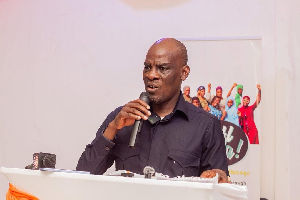
 Haruna Iddrisu speaking at the School for Life National Convening in Tamale
Correspondence from the Northern Region
The Minister of Education, Haruna Iddrisu, has disclosed that financial literacy, ethical integrity and Artificial Intelligence learning will be introduced in basic schools in the new curriculum for Ghanaian basic schools.
The minister said these new subjects will help prepare Ghanaian children adequately for the changing future.
Explaining the rational behind the introduction of the three new subjects in basic schools, Iddrisu said Ghanaian students must begin acquiring financial literacy skills to be able to do basic business transactions, hence the need for the introduction of financial literacy.
Speaking at School for Life’s National Convening on the State of Public Basic Education in Tamale on Saturday, the education minister explained that Ghanaian students need financial literacy skills to be able to do basic business transaction, hence the need for the introduction of financial literacy.
He added that ethical Integrity on the other hand would prepare students to grow up to be responsible and patriotic citizens who would serve the country with integrity and commitment, while Artificial Intelligence learning will prepare them to take up opportunities in the digital future.
“We’re reviewing curriculum currently and I intend to introduce three significant things to foundational learning. One, Financial Literacy. Our young people must begin acquiring financial literacy skills at the basic level. The other is ethical integrity. How do they grow up to be responsible and patriotic citizens who won’t plunder the resources of the state for other purposes other than for the good of the public? Electronics, coding, robotics and Artificial Intelligence must also be incorporated into foundational learning,” the minister said.
Sign Language to become an official Ghanaian language taught in schools
Speaking on inclusive education, Haruna Iddrisu disclosed that sign language will be introduced as an official Ghanaian language taught in schools.
“To promote inclusive quality education, we are increasing official Ghanaian languages taught in schools from 9 to 13, including sign language,” he added.
The Director of School for Life, Wedad Sayibu, emphasized the importance of social inclusion in achieving equity in educational access, noting that there is the need to address social and cultural barriers that prevent certain groups of children from fully participating in learning.
She said that “When policies do not reflect the unique needs of girls, children with disabilities, or minority communities, they reinforce exclusion. Social inclusion ensures that education responds to the diversity of learners, values every identity and their varied learning needs, and empowers every child to succeed. It is the foundation for achieving meaningful equity, not an optional add-on.”
Wedad added that she found it challenging that Ghana still had schools and education offices that are not disability-friendly, stressing the difficulty such situations pose to persons with mobility challenges.
“These realities must be addressed if we are to build an education system that is truly inclusive,” she stressed.

Copyright © 1994 - 2026 GhanaWeb. All rights reserved.










