



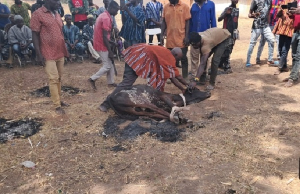
 A scene from the purification rites
Six months after the deadly Gbeniyiri conflict that left about 38 people dead and several others injured in parts of the Savannah Region, traditional authorities have carried out purification rites to cleanse the land and help the affected communities begin healing.
The rites, led by the Chief Priest of Tuna, Mwiri Kipo Huenhen, and supported by eight other traditional priests, were performed to appease the earth and honour the spirits of those who lost their lives during the violence, which spread across Gbeniyiri, Kalba and parts of Bole in the Sawla-Tuna-Kalba and Bole districts.
Speaking at Dagbebu, a suburb of Sawla, the chief priest described the rituals as a symbolic and spiritual end to the bloodshed, stressing that the communities had agreed to close the chapter and move forward, a report by myjoyonline.com said.
“This matter [Gbeniyiri conflict] has come to an end today. Families and stakeholders have agreed and are here to witness the purification. So, the conflict is over now. We pray to God and our ancestors that it never happen again, nor should a fight occur here,” he said.
He issued a strong warning to anyone who may attempt to revive tensions.
“And if someone here or anywhere is still thinking otherwise about the conflict, and picks a gun or any weapon, he or she will have the gods and ancestors to contend with,” he stated.
According to him, the rituals were not only about tradition but also about giving families closure, easing the pain of what happened, and creating room for peace, unity and development.
The conflict began in August 2025 after a dispute over a ten-square-metre parcel of land in Gbeniyiri escalated into violence.
The matter was reportedly taken to the palace of the Gbeniyiri chief for settlement, but one party rejected the decision, sparking clashes that quickly spread beyond the community.
The purification rites started at Janivuro, near Gbeniyiri — the area where the first five of the 38 victims were killed — before moving to Dagbebu for further rituals.
Gbiniyiri Clashes: What we know so far
As part of the ceremonies, the priests offered sacrificial items including cows, sheep, fowls and drinks to the earth, in line with customary practices aimed at restoring calm and spiritual balance to the land.
Chairman of the Savannah Regional Peace Council and member of the Gbeniyiri mediation committee, Reverend Father Lazarus Annyereh, praised the traditional leaders for taking the step, describing it as an important contribution to peacebuilding efforts.
“What I’ve seen here is a clear desire for sustainable peace in the area. And the chief priest’s statement exhorting everybody to lay down weapons and promote sustainable peace in the area has resolved part of our assignment,” Rev Fr Annyereh stated.
He added, “I’d like to say that it is a very strong contribution as far as the mediation and the dialogue mediation committee among the Lobi-Brifor-Gonjas are concerned.”
Rev Fr Annyereh further explained that his presence as a Catholic priest was also meant to send a message of unity and shared commitment to peace.
“Just to witness also tells people that the church is interested in African religion, especially religion that promotes peace, not religion that brings division. And what I’ve seen here is the promotion of peace, and it convinces me that we can work together in solidarity,” he said.
Meanwhile, efforts to rebuild what was destroyed during the conflict are also underway.
A new palace has been constructed to replace the Gbeniyiri chief’s palace, which was burnt down during the unrest.
Traditional leaders and key stakeholders, including members of the Lobi-Brifor Council of Elders, as well as the Dagaaba chief and his elders, were present to witness the rites.
NA/AE
'Veep has chosen Haruna Iddrisu as her running mate' – Afenyo-Markin alleges:
Meanwhile, watch more videos from the Minority's presser on government accountability below:

Copyright © 1994 - 2026 GhanaWeb. All rights reserved.










