



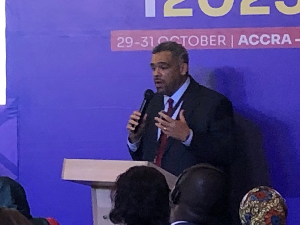
 Pia Rebello Britto is UNICEF’s Global Director for Education and Adolescent Development
Correspondence from Eastern Region
A coalition of leading global education bodies has launched a comprehensive, evidence-based roadmap aimed at addressing the growing literacy crisis affecting children across low- and middle-income countries (LMICs).
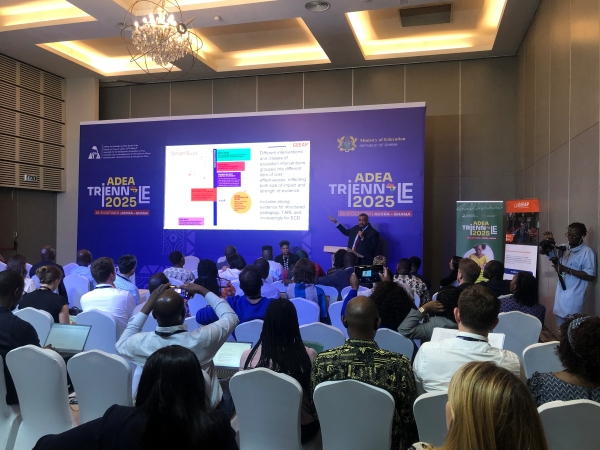
The new report, titled Effective Reading Instruction in Low- and Middle-Income Countries: What the Evidence Shows, was unveiled at the ADEA Triennale in Ghana.
It argues that the crisis—driven largely by teachers’ lack of confidence and reliance on ineffective instructional methods—can be reversed through a systematic focus on six core reading skills.
Endorsed by the Global Education Evidence Advisory Panel (GEEAP), co-hosted by the UK’s Foreign, Commonwealth & Development Office (FCDO), UNICEF, and the World Bank, the report comes amid alarming statistics that underscore the depth of the global learning crisis.
Scale of the Crisis
According to World Bank data from 2022, 70% of children in LMICs cannot read and understand simple, age-appropriate text.
The situation is most severe in Sub-Saharan Africa, where the learning poverty rate stands at an estimated 89%.
Further research analysing data from over half a million students across 48 LMICs revealed that after three years of schooling, more than 90% of pupils struggle to identify letter names, letter sounds, or read simple words at the expected level.
The report identifies the failure to implement evidence-based reading instruction as a key driver of this crisis.
“Too many children are in school but not yet learning to read. This report underscores how literacy lies at the very core of a child’s learning trajectory—shaping their opportunities and future,” said Pia Rebello Britto, UNICEF’s Global Director for Education and Adolescent Development.
The paper emphasises that investing in proven reading methods during the early years of schooling can significantly reduce the need for costly remedial programs, decrease grade repetition, and lower school dropout rates.
Reading Must Be Explicitly Taught
Drawing from around 120 studies conducted across Africa, Asia, Latin America, and the Middle East—and covering instruction in more than 170 languages, including Arabic, Chichewa, isiZulu, Kikamba, Kiswahili, and Setswana—the research finds that reading is not a naturally acquired skill but one that must be explicitly taught through structured instruction.
“A central finding of science-based approaches to reading is that children do not learn to read naturally; they must be explicitly taught,” stated Nompumelelo Mohohlwane, co-author of the report and Deputy Director at South Africa’s Department of Basic Education.
“Identifying the specific skills needed for all languages, including African ones, is a crucial step toward improving literacy practices.”
The six core skills identified in the report are:
Oral Language Skills – Focused instruction in listening, speaking, and vocabulary development.
Phonological Awareness – The ability to recognize and manipulate sounds in spoken language.
Systematic Phonics Instruction – Explicit teaching of letter-sound relationships to form words.
Reading Fluency – Developing accuracy and speed in reading to support comprehension.
Reading Comprehension Strategies – Teaching techniques to understand and monitor text meaning.
Writing Skills – Instruction in writing, spelling, and composing texts to reinforce reading proficiency.
Policy Recommendations for Governments
The report calls on policymakers to make transformative changes to empower teachers and ensure children receive the necessary instruction to build strong reading foundations.
“Literacy is the cornerstone of education, lifelong learning, and meaningful employment,” said Luis Benveniste, World Bank Global Director for Education and Skills.
It outlines five key recommendations for policymakers:
National Commitment – Establish a national pledge to ensure all children become skilled readers through evidence-based instruction.
Language Choice – Adopt appropriate languages of instruction and provide support for children to learn in those languages.
Explicit Instruction – Deliver systematic instruction in all six core skills, ensuring ample time for practice and engagement with diverse texts.
Adaptation – Tailor universal reading principles to suit local contexts and language characteristics.
Effective Implementation – Strengthen teacher capacity through structured support, quality materials, and continuous professional development.
“These approaches offer a practical, evidence-informed plan for improvement,” said Nathanael Bevan, Deputy Director for Research at FCDO.
“They can be adapted to local contexts, cultures, languages, and educational goals, with an accompanying how-to guide to aid implementation.”
The report’s findings will be further disseminated through a how-to guide scheduled for release in November, alongside translated versions and language briefs in French, Spanish, Arabic, and Hindi.

Copyright © 1994 - 2026 GhanaWeb. All rights reserved.










