



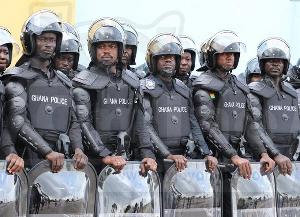
 Nene Bedjrah has called on the Police Service to engage the community on the Huhunya shooting range
Correspondence from Eastern Region
The Asafoatse of Sra and Huhunya in the Yilo Krobo Traditional Area of the Eastern Region, Nene Narh-Korli Bedjrah IV, has called on the Ghana Police Service to urgently engage community leaders to resolve an unresolved land-use arrangement involving a police training and shooting range at Huhunya.
In an interview with GhanaWeb, Nene Bedjrah IV disclosed that about ten years ago, the police administration approached traditional authorities of Huhunya, requesting a portion of community land for training purposes, including the establishment of a shooting range.
According to him, while the community agreed in principle and released land for temporary use, no binding agreement was concluded to define the terms, compensation, or duration of the occupation.
“The police assured us that our children would be prioritised during recruitment exercises as part of the arrangement, but this promise has not been honoured over the years,” the traditional leader stated.
He further noted that farming activities around the training area have been severely restricted due to frequent shooting exercises, depriving local farmers of their livelihoods without any form of compensation.
Concerned by the prolonged silence and lack of a formal agreement, the Tsatse Adjirackor family of Sra and Huhunya, through their legal representatives, wrote to the Inspector-General of Police on May 17, 2023, formally inviting the Ghana Police Service to negotiate terms and conditions for the continued occupation and use of the land.
The letter, authored by private legal practitioner M. Kofi Amoatey, recalled that the initial consent granted by the late chief and elders was provisional and subject to negotiations, which have yet to take place.
The letter warned that failure by the police to conclude negotiations within 90 days could compel the family to initiate steps to repossess the land. Copies were sent to key police authorities, including the Commandant of the Police Training School in Koforidua and the Eastern Regional Police Commander.
However, Nene Bedjrah IV lamented that more than two years after the letter was dispatched, no response has been received from the police administration. He said growing frustration among the youth had nearly resulted in a demonstration to reclaim the land, but traditional leaders intervened to maintain calm.
“We have restrained the youth for now, but if the police continue to ignore our calls, we may have no option but to mobilise and reclaim our land,” he warned.
He also raised concerns about allegations that some individuals have been recruited into the police service under the name of the Huhunya community without the knowledge or involvement of traditional authorities.
Beyond the land dispute, the Asafoatse appealed to the government to address pressing development challenges in Huhunya and surrounding communities. He called for financial support to enable the youth to venture into farming and become economically self-reliant, stressing that limited access to capital remains a major barrier.
The traditional leader expressed deep concern over the absence of a functional police station serving Huhunya and surrounding communities, describing the situation as a major security gap for the growing area.
According to him, residents currently rely on distant police posts for assistance, resulting in delays in response to crime and emergencies. He noted that this has left community members feeling vulnerable, particularly at night and during peak farming seasons.
Nene Narh-Korli Bedjrah IV explained that the community, through self-help initiatives, began the construction of a police station several years ago to support law enforcement and improve security.
However, the project has stalled due to the lack of funds and government backing.
He said the incomplete structure stands as a reminder of the community’s willingness to partner with the state, adding that without logistical and financial support, the facility cannot be completed or equipped for police use.
He, therefore, appealed to the government and the Ghana Police Service to prioritise the completion of the police station as part of efforts to strengthen security in the area.
According to the Asafoatse, a fully operational police post would not only deter criminal activity but also build trust between residents and the police, improve intelligence gathering, and enhance peace and stability in the area.
He also appealed for government intervention to replace a dilapidated public place of convenience and construct a community centre to host meetings and social activities.
According to him, these projects are vital to improving security, sanitation, social cohesion, and the overall well-being of the people.

Copyright © 1994 - 2026 GhanaWeb. All rights reserved.










