



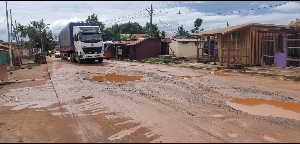
 The current state of the Akuse-Amedeka Road
Correspondence from the Eastern Region
Tensions are mounting in the Akuse-Amedeka area of the Lower Manya Krobo Municipality in the Eastern Region, as residents express growing frustration over the Volta River Authority’s (VRA) continued failure to rehabilitate a critical road connecting the community.
This comes on the back of growing frustration among residents, who say the state utility has consistently ignored its host community.
The issue has reignited public debate about the VRA’s accountability to Akuse, especially after recent meetings between VRA executives and the community yielded no concrete commitments to road construction or local development.
The Akuse-Amedeka road, which residents say has become nearly impassable, lies in a community that hosts one of Ghana’s major national assets — the Kpong Hydro Power Station.
Community members argue that while VRA benefits from the area’s land and resources, it has delivered little in return in terms of development.
At the center of the storm is Samuel Fletcher, a native of Akuse and now Deputy Chief Executive of the VRA, whose recent meeting with community members yielded no tangible outcomes with frustration mounting in the absence of any concrete plans.
“He spoke like we were asking for too much.Like we didn’t deserve better roads on our land — and yet he tried to gag us from social media advocacy.”
Community leaders have grown increasingly vocal in their criticism. Nene Otibo, a chief from the Osudoku Traditional Area, accused VRA of betrayal.
“You cannot keep using our land, ignoring our roads, and coming back only when you feel threatened. If this is how VRA treats its landlords, then it is shameful. We deserve better, and we will not accept these empty talks anymore.”
Lambert Donkor, a development advocate and Akuse native, echoed these sentiments, stating bluntly; “For the past 43 years of operations in Akuse, there’s no CSR project that can be attributed to VRA — not a single one.”
The Kpong Hydro Power Generation Dam was commissioned in 1982 and continues to serve as a key support to the Akosombo Dam, powering homes and industries nationwide.
Despite this national role, Akuse has reportedly seen minimal investment from the VRA. Residents point to a lack of basic infrastructure, including the absence of proper roads, education support, and livelihood projects.
“This is not just a development gap, it is an ethical failure,” Donkor said.
He criticized the VRA’s approach to corporate social responsibility (CSR) as superficial and performative.
“CSR is not a box to tick. It is a moral obligation. A responsible organization ensures that its landlords, like the people of Akuse — are not left behind while it thrives.”
According to Donkor and others, the community has sacrificed land and livelihoods in the name of national progress, yet received virtually no benefit in return. The ongoing neglect, they say, reflects a failure of ethical corporate citizenship.
“Is this what ethical corporate citizenship looks like?” Donkor asked. “Is VRA living up to its social contract with Akuse? Or is this simply a case of resource extraction without responsibility?”
The community’s frustration has now reached a boiling point, with local leaders, youth groups, and civil society organizations demanding a clear, transparent development plan from VRA.
They are calling for documented commitments, including timelines, budget allocations, and measurable development outcomes.
To further press home their demand, the people are considering a demonstration against the Volta River Authority (VRA) over the situation.
As pressure continues to mount, the VRA is being urged to demonstrate real accountability and to recognize the community’s role not only in supporting national energy needs but in sustaining the VRA’s operations over the past four decades.

Copyright © 1994 - 2026 GhanaWeb. All rights reserved.










