



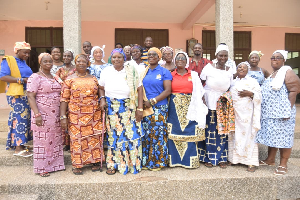
 Shai Queen Mothers are reviewing and reforming aspects of the Dipo customary rites
The Shai Queen Mothers Association in the Greater Accra Region has held a high-level forum to discuss, review and push to reform aspects of the Dipo customary rites, with the aim of protecting the rights and welfare of girls while preserving the cultural significance of the age-old tradition.
The forum, held on Tuesday, December 16, 2025, at the Shai Traditional Council in Dodowa, was themed “Protecting the Rights of Girls During Dipo Rites: The Role of Traditional Authorities.”
It brought together queen mothers, Dipo custodians, Setseme (stool leaders), and other traditional stakeholders from across the Shai Traditional Area.
The president of the Shai Queen Mothers Association, who is also the queenmother of Manya Shai, Nana Ayerko Blemayo II in her opening remarks, mentioned that dipo is one of the sacred traditions of the Shai people with many components that transition girls into womanhood and gives them a sense of cultural identity.
There's therefore the need to bring all stakeholders round the table to discuss ways to make the ceremony safer and healthier for girls. " we are here today to discuss how we can make the dipo attractive and more beneficial to our girls", she remarked.
At the forum, the Greater Accra Regional Director for the Department of Gender Matilda Banfro congratulated the leadership of Shai Queenmothers Association, adding that the forum was necessary and timely.
The regional gender director also delivered a presentation on "addressing harmful cultural practices to promote the rights of girls" where she exposed participants to some of the harmful cultural practices that affect mostly girls and their education and wellbeing.
Nana Dr Korlekwor Korli-Yohi III, Queen Mother of Agomeda and the Hiome Division, in her delivery, said the engagement was prompted by growing concerns about practices within the Dipo rites that no longer align with contemporary realities and international human rights standards.
“Today, we met with Dipo custodians and traditional leaders to discuss how the rites are performed and push for reforms that will make the practice more beneficial to young women,” she said.
“We have realised that when Dipo is well managed and implemented with better approaches, it can serve as a platform for meaningful life lessons and development for the girls.”
Dipo is a traditional puberty rite practised among the Krobo people, including the Shai, Yilo and Manya Krobo areas. Historically, it marks a girl’s transition into womanhood and readiness for marriage.
The rites, which are usually performed in January, are deeply rooted in Krobo history and are intended to instil moral discipline, cultural identity, respect for womanhood and sexual responsibility.
Traditionally, girls who undergo Dipo are introduced to Krobo customs, taboos and values, and are celebrated by their families and communities. However, some aspects of the rites—such as public parading, partial nudity and certain ritual practices—have in past and recent years attracted criticism and contributed to declining participation.
Nana Dr Korli-Yohi III noted that some of these practices are now outmoded and counterproductive.
“We are in a modern era and a global world, and our customs must reflect current realities,” she said. “Exposing the breasts of young girls and parading them through principal streets does not help them or society. Many girls run away from the practice because they are mocked by their peers, and some even drop out of school as a result.”
She also raised concerns about ritual acts that can traumatise participants, including the slaughtering of animals in the presence of the girls and the sprinkling of blood on them.
According to her, such practices discourage families from allowing their daughters to participate and reinforce the perception of Dipo as pagan worship.
As part of the proposed reforms, the Shai Queen Mothers Association is advocating a restructured Dipo that emphasises education, empowerment and well-being.
The reformed rites are expected to include cultural education, skills training, counselling, and health screening for participating girls, while eliminating practices deemed harmful or degrading.
“We want Dipo to become a space where girls learn about their culture, receive guidance on responsible living, and are empowered for the future,” Nana Dr. Korli-Yohi III explained. “It must also be clear that Dipo is not a licence for promiscuity but a foundation for disciplined and responsible womanhood.”
She announced that the Dipo celebration will still take place in January, as customarily observed, and urged all families with girls of eligible age in the Shai Traditional Area to participate.
The queen mother observed" “A lot of things are going to change, this time, people will see Dipo differently. It will be attractive, useful and beneficial for the girls, their families and the wider community.”
The forum marks a significant step by traditional authorities in the Shai Area to balance cultural preservation with the protection of girls’ rights, as communities adapt long-standing traditions to meet contemporary social and human rights expectations.

Copyright © 1994 - 2026 GhanaWeb. All rights reserved.










