



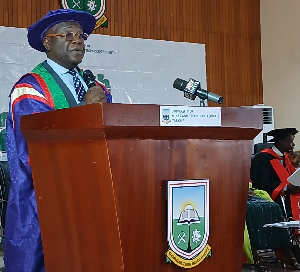
 Vice Chancellor of UMaT, Prof Richard Kwasi Amankwah
The University of Mines and Technology (UMaT) has officially admitted a new cohort of students at its 24th Matriculation Ceremony for the 2025/2026 academic year, marking the formal entry of thousands of fresh undergraduate and postgraduate students into the institution.
Addressing the matriculants, Vice Chancellor Prof. Richard Kwasi Amankwah described the ceremony as a significant rite of passage in the life of every tertiary student.
He explained that by signing the Register of Students, the freshers were not only gaining admission but also accepting the responsibilities and privileges that come with being members of the university community.
For the 2025/2026 academic year, the university received 21,489 applications, out of which 4,482 applicants were admitted into various undergraduate programmes — representing less than 25 percent of total applicants.
Professor Amankwah noted that the admission figures reflect the increasing competitiveness of entry into the university.
He also highlighted progress in gender representation, revealing that females now constitute 34 percent of admitted students, a significant improvement compared to previous decades.
Currently, 3,462 undergraduate students have been enrolled on the Tarkwa campus, while 110 students were admitted during the January postgraduate intake. This brings the total postgraduate population to 1,513 and the overall student population to 17,652.
The Vice Chancellor challenged students to approach their academic journey with seriousness and focus. He urged those who did not secure their first-choice programmes to remain committed, stressing that dedication and effort matter more than initial programme preference.
Professor Amankwah further underscored the importance of equipping students with skills relevant to the Fourth Industrial Revolution. He noted that the university has introduced several practical projects and industry-supported initiatives to strengthen students’ exposure to emerging technologies.
He also encouraged students facing financial difficulties to seek support through the university’s counselling and student assistance units, highlighting scholarship opportunities available through partners such as the Ghana Chamber of Mines, GNPC, and other industry stakeholders.
Additionally, students with innovative ideas were advised to take advantage of the university’s incubation hub to develop their projects into viable businesses before graduation.

Copyright © 1994 - 2026 GhanaWeb. All rights reserved.










