



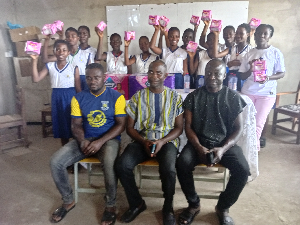
 Members of the Sir Bright Foundation at the donation excercise
Correspondence from the Eastern Region
A 13-year-old Junior High School (JHS) student of Halter Academy in Manya-Kpongunor in the Eastern Region, Tamara Oduekie Terkper, has taken a bold step to address menstrual health challenges among girls in her school and community through a campaign dubbed “One Girl, One Pad”.
Working in partnership with the Sir Bright Foundation, a non-governmental organization founded by her father, Bright Terkper — a teacher — Tamara distributed dozens of sanitary pads to her female colleagues as part of efforts to ensure that no girl misses school because of menstruation.
Tamara, who also serves as the Girls’ Prefect of Halter Academy, said she was moved by the plight of her peers who often miss classes or stay home during their periods due to the inability to afford sanitary pads.
“I can see most of my colleagues have problems when they are in their periods — some miss classes and some do not come to school at all because they don’t have pads,” she said in an interview.
“I hope the step I have taken will help them stay in school and perform well in their academics. It’s a good idea if the community comes on board to support girls who miss classes because of this problem.”
Addressing the gathering, Tamara said the gesture was not only about distributing pads but about building care, confidence, and equality among students.
“This gesture is not just about the pads; it’s about care and confidence — ensuring that no girl is left behind because of her period. Together we rise,” she said.
She appealed to Members of Parliament, chiefs, queen mothers, Assembly Members, and opinion leaders to help mobilize and provide sanitary pads to girls from underprivileged homes.
Her father, Bright Terkper, emphasized the need for sustainable community-driven solutions to menstrual poverty.
“As an educator, I’ve met many girls who miss school during their periods because they can’t afford pads. Menstruation is natural; it’s not something girls wish upon themselves,” he said.
“Government’s One Girl One Sanitary Pad initiative cannot reach everyone, so we must all help. Chiefs, MPs, queen mothers, assembly members — everyone must be part of this.”
He further advised girls facing such challenges to seek help from teachers or community leaders rather than resorting to risky behavior for financial support.
The Hidden Struggles Behind Menstrual Poverty
Menstrual health challenges remain a major obstacle to girls’ education and dignity.
Research shows that many schoolgirls, particularly in rural and low-income communities, miss between 3 to 5 school days each month because they cannot afford sanitary products.
Without proper menstrual materials, girls resort to using unhygienic alternatives such as cloth, tissue, or paper, which can lead to infections, embarrassment, and loss of confidence.
The stigma surrounding menstruation also discourages open discussion, leaving many girls to suffer in silence.
The situation often results in poor academic performance, absenteeism, and in some cases, early school dropout — widening the educational inequality between boys and girls.
Tamara’s initiative thus represents not only compassion but also a form of grassroots activism for menstrual equity — an issue that affects thousands of adolescent girls nationwide.
Community Leaders Call for Broader Support
Assemblyman for the Nuaso Old Town Electoral Area, Tetteh Isaac Kofi Nomo, commended Tamara’s initiative and underscored the urgency of making menstrual health support a national priority.
“I’ve had the chance to assist girls with sanitary pads in my area, and that’s when I realized it’s a serious problem. This should be a nationwide concern. The government cannot do it alone — opinion leaders must join the advocacy,” he said.
Similarly, the Assemblyman for the Kpongunor South Electoral Area, John Atter, urged collective community effort to complement government initiatives.
“The government is distributing pads to girls in schools, but that alone is not enough. We, the opinion leaders, NGOs, and community members, must also step in to help the girls in our schools and communities,” he said.
Empowering Boys
The campaign did not leave out the boys. Atter also donated 50 pairs of sandals to male students to support their education.

Copyright © 1994 - 2026 GhanaWeb. All rights reserved.










