



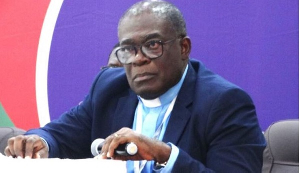
 Rev. Dr. Kwabena Opuni-Frimpong
A Senior Lecturer at the Department of Religion and Human Development at the Kwame Nkrumah University of Science and Technology (KNUST), Dr Kwabena Opuni-Frimpong, has called on the Presbyterian Church of Ghana (PCG) to strengthen its mission to traditional institutions, particularly the palace.
Speaking at the 2026 National Ministers’ Conference in Kumasi, Rev Dr Opuni-Frimpong urged the PCG to consider a constitutional review that would integrate royals and chiefs more fully into church life.
He proposed annual thanksgiving services to honour their contributions and the training of chaplains specifically for palace ministry.
“Ministers convinced of their calling to serve in the palace must be identified, trained, and encouraged,” he said.
He argued that mission to the palace is vital for bridging cultural gaps and ensuring that Christianity speaks to the heart of Ghanaian identity.
He further stressed that Christian mission must not be limited to individuals but should also extend to systems such as education, health, prisons, police, military, and media.
“Mission to systems is rooted in the transforming power of the Gospel,” he noted.
Rev Dr Opuni-Frimpong recalled historic appeals by traditional leaders, including Sir Nana Ofori Atta I’s request in 1941 for the Church to close the gap between the palace and the pew, and Nene Mate Kole’s call in 1960 for missionaries to assist chiefs in becoming Christians.
He also cited K. A. Busia’s warning in 1955 that the Church risked being seen as “alien” if it failed to engage traditional leaders.
He explained that chiefs and royals have long contributed to Christian missions through hospitality, land, security, and financial support. Yet, he observed, the Church has often resisted full integration of Christian royals, denying them communion, leadership roles, and recognition.
Quoting the PCG Constitution, he highlighted the tension between tradition and faith: “No Christian is expected to be a stool functionary”, saying that this was incompatible with the palace chaplaincy.
Rev Dr Opuni-Frimpong urged the Church to reconsider its approach, warning against syncretism but affirming the need for pastoral care and discipleship for converted chiefs.
“Chieftaincy” is a leadership institution, not a religious organisation. Chiefs may draw strength from any faith, and the Church must be present,” he said.
He emphasised the importance of chaplaincy ministries in extending Christian influence across Ghana’s social and traditional institutions.
He outlined how chaplaincy has historically created centres of worship in schools, hospitals, prisons, and security services, providing pastoral care, devotions, baptisms, confirmations, and weddings.
He noted that even the media has become a platform for Christian teaching, worship, and testimonies.
He urged theological institutions to incorporate palace ministry into their curricula, ensuring future ministers are equipped to engage traditional leadership with Christian values.
“The palace is not a religious organisation but a leadership institution. The Church must relate to it as it does with government, academia, and business,” he concluded.

Copyright © 1994 - 2026 GhanaWeb. All rights reserved.










