



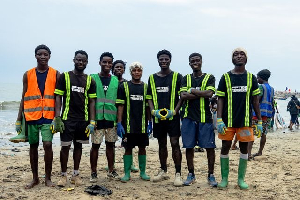
 The exercise attracted more than 200 participants
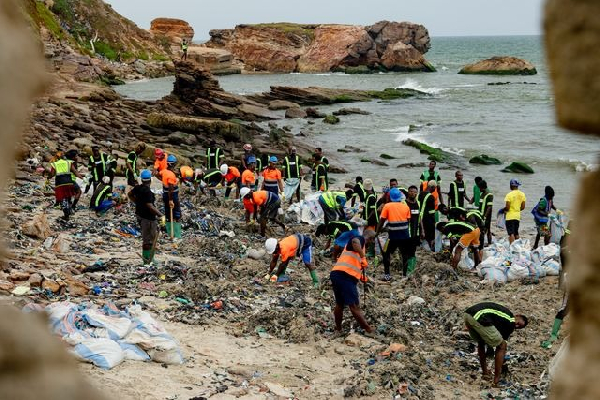
The OR Foundation, in collaboration with the Tide Turners Community Cooperative, has marked Ghana’s 2026 Constitution Day with a beach cleanup exercise at Kinshasha Beach, behind Ussher Fort in Jamestown, evacuating about 30 tonnes of textile and plastic waste.
The exercise, which attracted more than 200 participants, including community volunteers, formed part of ongoing efforts to reduce marine pollution and restore Accra’s coastline through sustained weekly clean-up activities, organisers said.
Speaking to the media after the exercise, Katia Ose, Environmental Justice Lead at the OR Foundation, said the intervention went beyond removing waste already washed onto the shoreline.
She explained that the organisation was also working upstream to prevent refuse from reaching the ocean.
According to her, the Foundation is operating in and around Kantamanto and parts of Agbogbloshie along the Korle Lagoon to curb the flow of waste into the sea, noting that shoreline cleanups could not be sustained without addressing pollution at its sources.
She added that the Foundation was partnering with various groups across the city to develop community-based waste management systems, supporting residents to handle the waste they generate more sustainably.
Ose said the long-term vision for the Kinshasha Beach stretch is ecological recovery that benefits both the environment and the local fishing community. She added that the Foundation hopes to see more trees planted along the beach within the next three to five years.
She also raised concerns about chemical pollution linked to textile waste, explaining that many dyes and chemical treatments used in garment production—such as those that make fabrics colourful or water-resistant—are not adequately monitored for their impact on marine ecosystems once discarded.
She said these chemicals are believed to enter the ocean alongside plastics and textile waste, raising concerns that fish ingest them and that the substances may subsequently move through the food chain to humans.
Meanwhile, the Environmental Field Operations Lead, David Akpabile, called for the development of infrastructure to recycle waste generated in the city, particularly unused and discarded clothing imported into the country, to prevent it from ending up in drains, lagoons, and ultimately the sea.
He said data from activities around Kantamanto indicated that a large volume of secondhand clothing becomes waste within a short period, arguing that the city’s limited disposal capacity makes marine pollution a likely outcome if recycling and recovery systems are not expanded.
According to him, the volume of unwanted clothing entering the country, combined with inadequate landfill capacity, means discarded garments can easily migrate into waterways and eventually wash up along the coast.

Copyright © 1994 - 2026 GhanaWeb. All rights reserved.










