



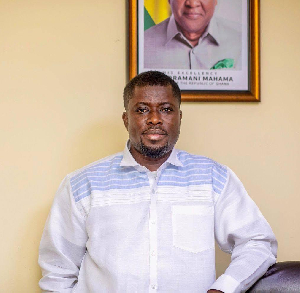
 Deputy Chief Executive Officer of the Forestry Commission, Elikem Kotoko
The ongoing legal and administrative challenges confronting Elikem Kotoko, Deputy Chief Executive Officer of the Forestry Commission, are increasingly being viewed by forestry experts and civil society groups as a calculated attempt to punish an official who has refused to compromise Ghana’s fight against illegal logging.
Elikem Kotoko has emerged as one of the most visible figures in the state’s enforcement drive against illegal lumbering, a multibillion-cedi criminal enterprise that continues to destroy forest reserves and deprive the nation of critical revenue.
His firm insistence on law enforcement, accountability, and revenue mobilization has reportedly made him a prime target of powerful cartels whose operations thrive on weak oversight and internal compromise.
“Once he decided not to look the other way, he became an enemy. The cartel realized he could not be bought,” a senior Forestry Commission source disclosed.
Standing Firm Against Illegal Logging
Since assuming office, Kotoko has directed field officers to strictly apply forestry regulations, intercept trucks transporting illegal lumber, and ensure that offenders are charged in accordance with the law.
These actions, sources say, significantly disrupted illegal timber routes and boosted internally generated revenue for the state.
However, rather than receiving institutional support, forestry staff who carried out his lawful instructions were subsequently interdicted, with their cases left unresolved months later.
Observers describe the situation as a deliberate attempt to intimidate officers and discourage enforcement.
“It created fear. People became afraid to do their jobs," a frontline officer explained.
Undermining Enforcement Through Intimidation
Forestry governance analysts argue that unresolved interdictions weaken operational confidence and embolden criminal networks.
“When law-abiding officers are punished and illegal operators roam freely, enforcement collapses,” an environmental policy expert stated.
The actions have further fueled suspicion that powerful interests within and outside the Commission are actively undermining reform efforts.
Resistance to National Timber Monitoring Team
Tensions escalated following the inauguration of the National Timber Monitoring Team (NTMT) by the Minister for Lands and Natural Resources, Emmanuel Armah-Buah.
The NTMT was established to enhance transparency, strengthen route monitoring, and eliminate illegal timber movements.
Sources within the forestry sector confirm that illegal logging cartels perceived the initiative as a serious threat.
“They openly said the NTMT must fail. They believe the minister went beyond his jurisdiction, and they want to make an example of those implementing the policy,” one source revealed.
Kotoko, whose office plays a central coordinating role in enforcement, has since faced increased resistance and legal pressure.
Enforcement Gaps
Logistical challenges faced by staff were exploited by illegal operators, prompting authorities to introduce measures to block the transportation of illegally harvested lumber. Multiple officials confirmed that the exercise formed part of routine management oversight.
“It was not a raid for personal benefit. It was an institutional review,” a source said.
Legal experts note that criminalizing such operational inspections could discourage senior officials from conducting field assessments.
Refusal to Join the Cartel System
Sources close to the matter allege that the illegal logging network expected Kotoko to remain silent and profit from forest exploitation—an expectation he outright rejected.
“They wanted him to take his share and keep quiet. But he chose the forest over money.”
Environmental groups say this refusal lies at the heart of the hostility he now faces.
“This is what happens when corruption meets integrity,” a civil society leader stated.
February 3 Court Hearing
The case is scheduled to resume at the Tepa Magistrate Court on February 3, 2026.
Forestry stakeholders believe the proceedings will be closely monitored as a test of Ghana’s commitment to environmental justice.
“This is bigger than one man. It is about whether the country protects officers who enforce the law,” an environmental activist said.
Calls for Protection for Reform Officers
As Ghana intensifies its climate action commitments and sustainable forestry agenda, experts are calling for strong political and institutional backing for officials implementing government policy.
“If enforcement officers are left vulnerable, illegal logging will continue unchecked,” a governance analyst warned.
Supporters of Kotoko maintain that his actions align fully with national policy and the Forestry Commission’s mandate.
“He acted within the law, in the interest of the state. Punishing him would send the wrong message," a senior official emphasized.
Despite the pressure, those close to the Deputy CEO say he remains focused.
“His position is simple. Ghana’s forests must be protected — no matter whose interests are threatened," an aide stated.

Copyright © 1994 - 2026 GhanaWeb. All rights reserved.










