



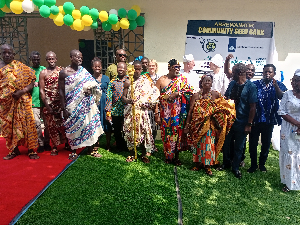
 The facility is the second community seed bank to be established in Ghana
The farming community of Abrewankor in the Yilo Krobo Municipality of the Eastern Region has inaugurated a state-of-the-art Community Seed Bank, marking a significant milestone in Ghana’s efforts to conserve indigenous crop varieties, strengthen food security, and promote sustainable agriculture.
The facility, which is the second community seed bank to be established in Ghana after the first at Mangoase, also in the Eastern Region, was commissioned on Monday, January 26, 2026, at a colourful ceremony attended by traditional leaders, government officials, development partners, farmers, students, and civil society organisations.
The community-driven agricultural innovation, is to preserve indigenous seeds, strengthen climate resilience, and empower smallholder farmers through sustainable seed banking.
The initiative is spearheaded by NUS Network-Ghana in collaboration with Alliance Bioversity International and CIAT under the CGIAR framework, with funding support from the Anton Jurgens Fonds through the Embassy of the Kingdom of the Netherlands with the Ghana Food Movement as a key partner.
Speaking at the event, the Coordinator of NUS Network-Ghana, Dr Daniel Nyadanu, explained that community seed banking is a strategic approach aimed at conserving the genetic resources of local crops that communities have preserved over generations.
“Through continuous farmer selection, these seeds have evolved to become highly adaptable to local environments and are deeply embedded in community food systems, nutrition, and culture. However, urban expansion, housing development, and climate change are rapidly eroding these valuable genetic resources,” he said.
Dr Nyadanu noted that traditional seed conservation methods, such as drying and storing seeds in household kitchens, are no longer sustainable. He said the establishment of community seed banks offers a structured and long-term solution for safeguarding indigenous crop varieties.
The Abrewankor Community Seed Bank currently holds 58 documented seed accessions, including maize, cowpea, groundnut, millet, and several neglected and underutilised species such as fonio.

These seeds will be made available to smallholder farmers, who typically cultivate between two and four acres primarily for household consumption and income generation.
Under a regeneration system, farmers who receive seeds are required to return a portion of their harvest to the seed bank, ensuring sustainability, continuous availability, and genetic viability.
Beyond conservation, the seed bank is envisioned as a centre for farmer training, innovation, and value addition. Farmers will be trained in improved agronomic practices, seed management, and climate-smart agriculture, while plans are underway to establish a processing and resource centre for seed drying, crop processing, and value addition.
“This facility will also host a local market where farmers can sell both raw and processed products, thereby improving incomes and livelihoods,” Dr Nyadanu added.
Currently, about 200 farmers are directly involved in the initiative, with projections that participation could grow to thousands across the municipality and beyond.
Commissioning the facility, the Municipal Chief Executive (MCE) for Yilo Krobo, Francis Addo Akumatey, described the seed bank as a strategic investment in Ghana’s agricultural heritage, food security, and climate resilience.
“This seed bank is not just about infrastructure. It is about safeguarding our indigenous seeds, strengthening our resilience to climate change, and securing the future of our farmers and communities,” he stated.
He stressed that indigenous seeds are repositories of culture, history, and agricultural wisdom, valued for their resilience, nutritional quality, and adaptability to local conditions.
Akumatey warned that increasing dependence on imported hybrid seeds, climate variability, and environmental degradation pose serious threats to Ghana’s food systems. He said the seed bank would help counter these challenges by preserving local varieties while supporting climate-smart agricultural practices.
The Assembly Chief also linked the initiative to the government’s Feed Ghana Programme, describing it as complementary to national efforts aimed at boosting local production, modernising agriculture, and creating employment, particularly for the youth.
In an interview with the media, Akumatey emphasised that one of the core objectives of the seed bank is to reduce the cost of farming.
He expressed concern about genetically modified seeds, explaining that many are engineered with terminator genes, preventing farmers from reusing harvested seeds. This, he said, forces farmers to buy new seeds every planting season, significantly increasing production costs.
“Indigenous seeds can be grown, harvested, and replanted over multiple seasons, making farming more affordable and sustainable. That is why preserving them is critical,” he said.
Representatives of the Netherlands Embassy, the Anton Jurgens Fonds, and Bioversity International & CIAT all highlighted the importance of youth involvement in ensuring the sustainability of the seed bank.
Agriculture Counsellor at the Netherlands Embassy, Madam Tenniglo Inge, described the project as a powerful example of community-driven development and praised the strong participation of farmers and students.
She revealed that although 35 farmers were initially invited for training, more than 70 attended, demonstrating strong local interest and commitment.
“What makes this project especially inspiring is that it was initiated at the request of the school headmaster. This shows that communities themselves are driving change,” she said.
Inge further reflected on the global relevance of community seed banks, noting that food diversity has declined worldwide, including in Europe, and that Ghana’s experience offers valuable lessons for restoring neglected and underutilised crops.
The Headmaster of Abrewankor Basic School and the Chairman of the Community Seed Bank both expressed gratitude to the donors and partners, urging farmers to take ownership of the facility.
“Our chief generously donated the land, and the community has embraced this project wholeheartedly. Seeds will be given out freely, but farmers must return a portion of their harvest to replenish the stock so others can benefit,” the chairman said.
Traditional leaders, municipal authorities, and farmer-based organisations were also urged to safeguard the facility and ensure its effective management.
The Chief of Abrewankor and Chairman of the occasion, Nene Tetteh Addey I, warmly welcomed the establishment of the Community Seed Bank in his community. He expressed profound gratitude to the donors and development partners for their support, describing the project as timely and beneficial to both present and future generations.
The Chief assured stakeholders of his personal commitment and pledged the full support of the Abrewankor community to protect, manage, and sustain the facility to ensure that its intended benefits are fully realised.
The inauguration ceremony featured poetry recitations, drama, choreography, musical performances, and exhibitions of indigenous crops and value-added products, underscoring the cultural and educational dimensions of the initiative.
With growing threats from climate change, urbanisation, and declining biodiversity, the Abrewankor Community Seed Bank stands as a model for community-driven agricultural resilience, conservation, and sustainable development.
As Ghana seeks to strengthen its food systems and reduce dependence on imported seeds, the Abrewankor experience offers a compelling blueprint for scaling community seed banking nationwide.

Copyright © 1994 - 2026 GhanaWeb. All rights reserved.










