



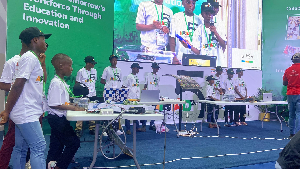
 The event brought together policymakers, industry leaders, development partners and students
The Director-General of the National Council for Curriculum and Assessment (NaCCA), Professor Samuel Bekoe, has declared that Ghana’s education system is no longer preparing learners for a stable world but for one defined by rapid disruption, artificial intelligence and automation.
Speaking at the 5th Edition of the Annual Impact Roundtable Discussion (AIRTAD) and Robotics Competition 2026 on February 26, 2026, Professor Bekoe said the theme for this year, “Shaping Tomorrow’s Workforce Through Education and Innovation” sits at the very heart of NaCCA’s mandate.
“We are no longer preparing learners for a world that stays still; we are preparing them for a world of rapid disruption, artificial intelligence and automated systems,” he stated.
“Our mandate has been clear: to transform the Ghanaian educational landscape from a system of mere ‘chill and recall’ to one of ‘think and create.’”
Professor Bekoe noted that through the Standards-Based Curriculum and the Common Core Programme, technology has been integrated not as an isolated subject but as a foundational language for the 21st-century learner.
Speaking on behalf of the Director-General of the Ghana Education Service (GES), Dr Olivia Serwaa Opare, Director of the STEM Unit, described the gathering as more than just an event.
“This is not just a robotics competition. It is a statement of intent, a collective commitment to shaping the future of education and preparing our young people for the rapidly evolving world of work,” she said.
Dr Opare emphasised that globally, education systems are being challenged by technological change, artificial intelligence, automation and new economic realities. Many of the jobs today’s students will occupy in the future, she noted, do not yet exist.
She highlighted Ghana’s bold reforms through the Standards-Based Curriculum and the National STEM agenda, which have shifted the system from memorisation to creativity, inquiry and practical problem-solving.
However, she cautioned that curriculum reform alone cannot transform learning.
“Transformation happens when learners are given environments where they can experiment, design, fail safely, try again, and ultimately create solutions,” she explained.
Dr Opare praised the Yamoransa Model Labs Programme as a practical demonstration of meaningful STEM education, especially in underserved communities by introducing makerspaces, robotics, coding and hands-on science learning, she said the initiative bridges the gap between theory and practice.
“It allows students not only to learn science, but to do science. Not only to study technology, but to create technology,” she stressed.
Professor Kofi Sarpong Adu Manu, Associate Professor at the Computer Science Department of the University of Ghana, underscored the importance of government-private sector collaboration in sustaining STEM education.
He noted that while previous administrations made significant strides in promoting STEM, continuity and strong public-private partnerships would ensure long-term sustainability.
“Government has the authority and resources. Partnering with the private sector to support STEM education will make the initiative sustainable,” he said.
Laurin Assiamah-Yeboah, Head of Portfolio and Operations for IMPLEMENTERS, revealed that discussions are underway with partners to scale the model and align it with Ghana’s national curriculum.
“At the end of the day, if students are taught science, technology, engineering, arts, and mathematics without practical spaces to apply them, the learning does not last,” she explained. “When we provide the facilities and the environment, learning becomes practical and meaningful.”
She expressed optimism that STEM education would significantly transform Ghana’s educational sector in the coming years, urging stakeholders to act with urgency.
“This is not tomorrow’s conversation; it is today’s responsibility,” she added.
Country Director of UNESCO Ghana, Edmond Moukala, linked the initiative to the global 2030 Agenda, particularly Sustainable Development Goal 4, which seeks to ensure inclusive and equitable quality education for all.
He commended organisations translating global education frameworks into tangible classroom experiences, stressing that innovation must become a right for the many and not a privilege for the few.
Counsellor and Deputy Head of Mission at the Embassy of Japan in Ghana, Naoki Mitori, also encouraged young people to believe in their potential.
“Ghana is a land of promise and possibilities. If you believe in your potential and give your best effort, you will be able to achieve your dreams,” he said, congratulating organisers and stakeholders for their commitment.
The 2026 edition is particularly significant as it marks five years of AIRTAD, a flagship initiative assessing the impact of the Yamoransa Model Labs Programme while celebrating innovation, creativity and problem-solving among young people in Science, Technology, Engineering, Arts and Mathematics (STEAM).
The event, organised by IMPLEMENTERS, brought together policymakers, industry leaders, development partners and students from Ghana, Liberia and The Gambia to engage in critical discussions on the future of education and workforce development in Africa.
AM
Meanwhile, watch GhanaWeb’s exposé on the 'dark side of Kayamata' and its devastating impact

Copyright © 1994 - 2026 GhanaWeb. All rights reserved.










