



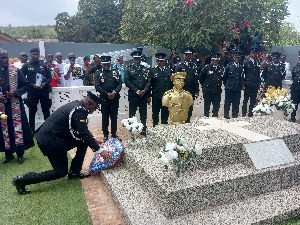
 Wreaths were laid at the burial site on behalf of the family, traditional leaders, and the police
Correspondence from Eastern Region
Events have been held to commemorate the 30th anniversary of the passing of Ghana's first indigenous Inspector General of Police, Erasmus Ransford Tawiah Madjitey, with tributes highlighting his pioneering role in law enforcement, politics, and public service.
The commemoration, held at his residence at Asitey near Odumase Krobo in the Eastern Region on Saturday, April 11, 2026, brought together the family of the late IGP, the Ghana Police Service, and the people of Manya Krobo to honour his enduring legacy.
At the ceremony, attended by the police management board and police personnel, traditional leaders and dignitaries, various speakers noted the symbolic significance of Madjitey's tenure as police chief.
Delivering a family tribute, Carl Tetteh Madjitey, eldest surviving son of the late statesman, described his father as a man of exceptional discipline and principle, guided by the philosophy “Primus Inter Pares” (first among equals).
Born on November 11, 1920, at Aframase to Asafoatse Madjitey II and Madam Ogbeko, Madjitey demonstrated strong intellectual promise from an early age despite what his family described as a “restless and mischievous” childhood.
He received his early education in Odumase Krobo before attending Adisadel College and later graduating from Mfantsipim School in 1940.
He proceeded to Achimota, where he obtained an Inter BA with distinction from the University College of Achimota.
Rise through the police ranks
Madjitey joined the Gold Coast Police Force in 1944 under a special graduate recruitment programme. His rise through the ranks was rapid and remarkable, particularly within a colonial system dominated by British officers.
He received advanced police training in the United Kingdom, including at Lancashire Constabulary and later at Scotland Yard, and held several key positions across the Gold Coast.
In 1956, at just 36 years old, he became the first Ghanaian to command a police region. Two years later, following Ghana’s independence, he was appointed Commissioner of Police by Kwame Nkrumah.
Madjitey subsequently became the first African south of the Sahara to head a national police force within the British Commonwealth, achieving the feat at the age of 38.
Political turbulence and resilience
His tenure, however, was not without challenges. During a period of political instability, Madjitey and several senior officers were removed from office and detained.
Family members say this period tested his resilience but also defined his enduring strength of character.
“I mention this… to highlight his tenacity, resilience, and determination to succeed, even in the face of adversity,” Carl Madjitey noted.
Following his release after the 1966 coup, he was appointed Ghana’s High Commissioner to Pakistan, marking a transition into diplomacy.
Political and national service
Upon his return to Ghana, Madjitey entered politics, serving as Member of Parliament for Lower Manya Krobo.
He later became leader of the National Alliance of Liberals following the disqualification of K. A. Gbedemah, and subsequently led the Justice Party as leader of the parliamentary opposition.
He also played a role in Ghana’s constitutional development, contributing to the drafting of the Third Republic Constitution as a member of the constituent assembly.
Honours and legacy
Throughout his career, Madjitey received several honours, including a Commander of the Order of the British Empire (CBE) and the African Medal for Meritorious Police Duty.
Traditional leaders also recognised his contributions. The late Manya Krobo paramount chief conferred on him the title “Adeye-kote,” meaning “there is a warrior in the house.”
Speaking on behalf of the IGP who was the Special Guest of Honour, in a commemorative address, COP Dr. Saying Pabi Gariba - Director-General/National Patrols Department, described Madjitey as “an enduring symbol of integrity, leadership, and service,” whose legacy continues to shape modern policing in Ghana.
Traditional perspectives
Speaking in an interview, Nene Bediako Baah Mualla III, Divisional Chief of Dorm in the Manya Krobo Traditional Area, praised the late IGP as a statesman of great honour whose contributions spanned both security and politics.
“He has done a lot and should be remembered… we are proud to have him as a son,” he said, while urging current security leadership to draw lessons from his legacy.
He also called for stronger collaboration between traditional authorities and security agencies, stressing the importance of mutual respect in maintaining peace and security.
Enduring influence
Madjitey passed away in 1996, but speakers at the event emphasised that his legacy remains deeply embedded in Ghana’s institutional history.
“Thirty years after his passing, we remember not just a man, but a legacy,” COP Gariba stated. “His contributions to law enforcement in Ghana are indelible.”
Wreaths were laid at the burial site on behalf of the family, traditional leaders, and the police service.
As Ghana reflects on his life, many see his journey—from colonial police recruit to national figure—as a testament to leadership, resilience, and service to country.

Copyright © 1994 - 2026 GhanaWeb. All rights reserved.










