



 The govt will prioritise the university’s additional infrastructure needs to improve teaching
Correspondence from the Eastern Region
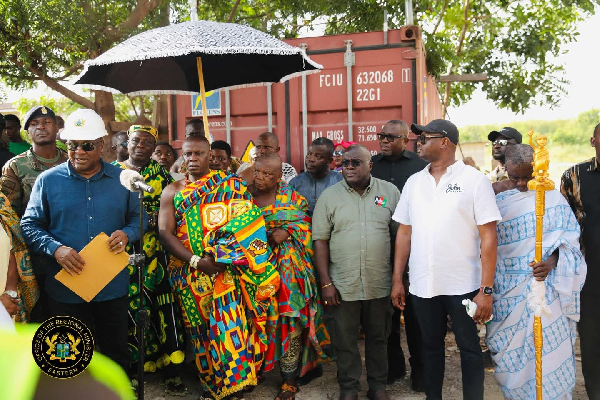
President John Dramani Mahama has reaffirmed government’s commitment to expanding infrastructure at the University of Environment and Sustainable Development (UESD) following an inspection of ongoing projects at the institution’s campus in the Eastern Region.
During the visit, the President described the university as a project of deep national and personal significance, pledging to transform it into a model institution for higher education in Ghana.
“This university is our own baby, and we have a very sentimental attachment to it. We want to make it a model for the whole of Ghana—a citadel of learning,” he said.
Infrastructure Expansion And Timelines
President Mahama disclosed that the university council has submitted a list of additional infrastructure needs, assuring that government would prioritise their completion to enhance teaching and learning.
He announced progress on key accommodation projects, including a 450-bed hostel expected to be completed by October this year, and an additional 800-bed facility scheduled for completion by February next year.
The facilities are intended to enable more students to reside on campus and improve academic outcomes.
“We will return in October and again in February to commission these projects,” the President added.
Vice-Chancellor Highlights Delays And Urgent Needs
The Vice-Chancellor of UESD, Prof Eric Nyarko-Sampson, noted that several infrastructure projects initiated as far back as 2016 remain incomplete, underscoring the need for urgent intervention.
According to him, the President’s visit provided an opportunity to assess stalled and ongoing works, including projects that are at various stages of completion—some exceeding 70 percent progress.
He explained that the university showcased both older and recently initiated projects, including those started earlier this year and expected to be completed by February 2027.
The Vice-Chancellor further outlined Phase Two of the university’s development plan, which comprises approximately ten projects. These include lecture halls, science laboratories, student accommodation, a two-kilometre asphalt road, and recreational facilities. However, he revealed that some components, particularly accommodation and recreational areas, have yet to commence.
“We are engaging the relevant authorities to ensure contractors return to site and complete the projects,” he said.
He also identified critical challenges facing the university, including inadequate accommodation, limited lecture space, and insufficient teaching and learning materials.
Traditional Leaders Welcome Visit, Raise Development Concerns
Meanwhile, the Divisional Chief of Okper, Nene Anyeenorgu Teye Agor IX, speaking on behalf of the Chiefs of the Yilo Krobo Traditional Area, welcomed the President’s visit, describing it as timely and necessary to accelerate development.
He noted that the inspection had rekindled hope in the community, as project monitoring is essential to ensuring timely completion.
The traditional authorities also used the occasion to raise concerns about delayed infrastructure projects in the area, particularly the Somanya–Kpong road. They appealed to the President to intervene by restructuring the contract to allow multiple subcontractors to speed up construction.
Additionally, the chiefs expressed appreciation for government appointments given to individuals from the area, describing them as unprecedented.
Expectations For Accelerated Development
The chiefs further highlighted broader community challenges, including access to water and road infrastructure, expressing confidence that the President’s direct engagement would translate into tangible improvements.
They emphasised that the President’s historical involvement in the establishment of the university—including acquiring land and initiating construction—positions him uniquely to ensure its successful completion.
With assurances of renewed government support and closer monitoring, both university authorities and community leaders expressed optimism that the visit would fast-track stalled projects and strengthen the institution’s role in Ghana’s higher education landscape.

Copyright © 1994 - 2026 GhanaWeb. All rights reserved.










