



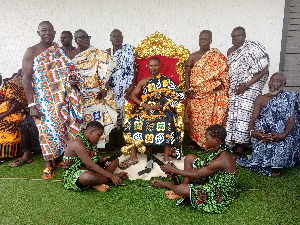
 Stakeholders gathered for a reconciliation durbar to promote unity ahead of the late chief
The Osudoku Traditional Council on Saturday, June 6, 2026, held a reconciliation durbar at Osuwem, aimed at fostering peace, unity, and healing among the people of Osudoku ahead of the final funeral rites of the late Paramount Chief of the Osudoku Traditional Area, Ngmorngmorwuyaa Kwesi Animle VI.
The event, which brought together chiefs, queen mothers, elders, opinion leaders, clergy, youth groups, family representatives, and other stakeholders, formed part of a broader effort by the traditional leadership to mend divisions and strengthen social cohesion before the funeral of the late traditional ruler.
The late Ngmorngmorwuyaa Kwesi Animle VI, who served as Paramount Chief and President of the Osudoku Traditional Council, reigned from 2014 to 2024.
He is remembered for his dedication to the development and administration of the traditional area. His passing left a significant void within the traditional hierarchy and among the people he served.
Addressing the gathering, the current Paramount Chief of the Osudoku Traditional Area and President of the Osudoku Traditional Council, Nene Kweku-Otiti Animle VII, underscored the importance of forgiveness and reconciliation as the traditional area prepares to bid farewell to its late leader.
He described the occasion as a historic moment for the Osudoku State, emphasising that the gathering was intended not only to remember the late chief but also to heal wounds and restore unity among the people.
"As tradition demands, when a great tree falls in the forest, the entire land feels its impact," he stated. "The passing of our late Paramount Chief has left a deep void in our traditional area. He served this state with commitment, strength, conviction, and passion."
The Paramount Chief acknowledged that leadership often comes with disagreements and misunderstandings and, therefore, extended an apology on behalf of the stool, palace, and family of the late chief to anyone who may have felt hurt, neglected, offended, or wronged during the reign of the deceased ruler.
"If harsh words were spoken, forgive. If misunderstandings arose, forgive. If wounds were created, let healing begin today. If divisions emerged among brothers and sisters, let them end here and now," Nene Kweku-Otiti Animle appealed.
He urged all clans, gates, families, youth groups, and stakeholders to set aside differences and support efforts to organise a peaceful and befitting funeral for the late Paramount Chief.
The durbar featured prayers by Christian, Islamic, and traditional religious leaders, cultural performances, Obonu drumming, the presentation of customary items, libation, a reconciliation sermon, and goodwill messages from invited dignitaries.
Providing further insight into the initiative, Secretary and Spokesperson for the Osudoku Traditional Council (Osudoku State), Nene Amanor Aklebeto I, explained that the reconciliation process was initiated after the installation of Nene Otiti Kwesi Animle VII, who became aware of longstanding disputes within sections of the traditional area.
According to him, the traditional council established various subcommittees to engage stakeholders and address grievances among families, clans, and individuals perceived to be aggrieved.
He disclosed that some of the major issues identified include divisions among the three royal gates that form the nucleus of the paramountcy—Animle Gate, Agblom Gate, and Amponsah Gate—as well as disagreements involving the Paramount Stool and the traditional priesthood.
In addition, the traditional area continues to grapple with several land and chieftaincy disputes, some of which are currently before the courts.
While admitting that complete reconciliation may not be achieved immediately, Nene Aklebeto expressed optimism about the progress made so far.
"Some stakeholders are still unhappy, but many have responded positively. Reconciliation is a process, not a one-day event. We will continue engaging all parties even after today's durbar," he said.
He noted that the attendance of some individuals who were not initially expected to participate in the event served as a strong indication that the peace initiative was yielding results.
The traditional council is targeting the end of October or early November for the funeral of the late Ngmorngmorwuyaa Kwesi Animle VI and hopes to intensify reconciliation efforts before the official launch of the funeral programme.
Nene Aklebeto further appealed to parties involved in court cases related to chieftaincy and land matters to consider alternative dispute resolution mechanisms and amicable settlements outside the courts in the interest of lasting peace and development.
He stressed that disputes are inevitable in every society but encouraged citizens to embrace dialogue, compromise, and forgiveness for the sake of future generations.
Among the traditional leaders present at the durbar were Nene Tetteh Sabaa Atakplai, Klekpa Divisional Chief; Nene Narteh Otutoto Akakposu, Kasunya Divisional Chief; Nene Narh Guamatsu IV, Tsangme Divisional Chief; Nene Teye Aborbi IV, State Linguist; Torgbe Dedu IV, Chief of Dedukope; and several other chiefs and queen mothers from communities across the Osudoku Traditional Area.
Participants expressed hope that the reconciliation process would pave the way for a peaceful funeral celebration and mark the beginning of a new era of understanding, cooperation, and unity within the Osudoku State.
The durbar ended with prayers for peace, healing, and successful preparations towards the final funeral rites of the late Paramount Chief, whose legacy continues to shape discussions about unity and development within the traditional area.

Copyright © 1994 - 2026 GhanaWeb. All rights reserved.










