



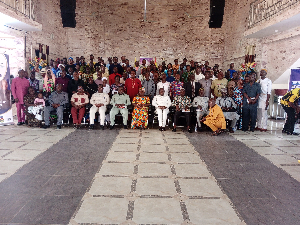
 Stakeholders at a two-day Suhum dialogue discussed child protection challenges and solutions.
Religious leaders, traditional authorities, assembly members and government officials in the Suhum Municipality of the Eastern Region have reaffirmed their commitment to protecting children from trafficking, exploitation and other forms of abuse following a two-day stakeholder dialogue organised by the International Justice Mission (IJM) Ghana.
The two day engagement, held at the LA Nyarko Pentecost Church in Suhum on Thursday and Friday, brought together key stakeholders to discuss child protection challenges within the municipality and develop collaborative strategies to address them.
The programme forms part of a growing partnership between IJM Ghana and members of Parliament's Human Rights Select Committee aimed at strengthening child protection mechanisms at the community level.
Welcoming participants to the dialogue, the Municipal Chief Executive for Suhum, Lydia Ohenewaa Sarah, in a speech read for her, described child protection as a collective responsibility and stressed that every child deserves to grow up in a safe, secure and nurturing environment where their rights are respected and their full potential can be realised.
She noted that despite ongoing efforts, many children continue to face abuse, neglect, exploitation, violence and other harmful practices that threaten their well-being and future.
She therefore called for stronger collaboration among government institutions, traditional authorities, religious organisations, civil society groups and community leaders to address the challenges confronting children in the municipality.
Ohene Asare commended the Office of the Member of Parliament for Suhum and IJM Ghana for facilitating the dialogue, describing it as an important platform for identifying gaps in existing child protection systems and developing practical recommendations to improve outcomes for children.
Richard Kwasi Offei, Community Engagement Specialist at IJM, said the organisation engaged traditional leaders, assembly members, municipal directors and faith-based organisations to draw attention to their collective responsibility in safeguarding children.
According to him, discussions focused particularly on child trafficking and the worst forms of child labour, which continue to affect vulnerable children in many communities.
Kwasi Offei explained that IJM's mission is centred on protecting vulnerable populations, particularly children who are at risk of trafficking and exploitation.
He noted that assembly members and municipal officials were targeted because of their influence in governance and policy implementation, while religious leaders were engaged due to their significant influence within the community.
Citing national population statistics, the Community Engagement Specialist said Christians and Muslims constitute about 91 per cent of the population, making faith leaders critical partners in promoting positive behavioural change and child protection advocacy.
Offei as part of the next phase of the initiative, disclosed that stakeholders would establish a Municipal Child Protection Committee to coordinate efforts aimed at protecting children and responding to emerging concerns within communities.
He also announced plans to use September's Freedom Month campaign to encourage churches and mosques to dedicate sermons and public engagements to child protection awareness.
The Member of Parliament for Suhum, Frank Asiedu Bekoe, said the stakeholder engagement was inspired by discussions he had held with IJM through Parliament's Human Rights Committee.
According to him, the municipality continues to grapple with several child welfare concerns, including child trafficking, child abuse, exploitation, teenage pregnancy, drug and substance abuse, and the spread of HIV/AIDS among young people.
"We agreed that IJM should come to Suhum to have a dialogue with stakeholders and help us fashion out strategies to deal with child protection issues in our communities," he stated.
Bekoe stressed that the responsibility for raising and protecting children begins at home and cannot be delegated entirely to schools, churches or other institutions.
"Parents should understand that protecting and training children starts from the home. Children spend more time in their homes than in any institution, so parents cannot leave their responsibility entirely to schools, churches or mosques," he said.
He revealed that the next stage of the initiative would involve the formation of community child protection committees that would work with the Municipal Assembly, the MP's office and IJM to engage parents directly on child welfare issues.
Chairman of the Suhum Local Council of Churches and Area Head of The Church of Pentecost, Apostle Patrick Aseyoro, described the programme as timely and relevant, noting that the future of the nation depends largely on how today's children are nurtured and protected.
He pointed to growing concerns over drug abuse and other social vices involving young people and called for stronger collaboration among government, religious institutions and families.
Apostle Aseyoro emphasised that while churches continue to invest in children's ministries and welfare programmes, parents remain the most important influence in a child's development.
"Every child comes from a home. We encourage parents to spend time with their children, pray with them and guide them. The church and schools can only complement what parents do," he said.
He further called on government to strengthen child protection policies and provide adequate resources to local assemblies and stakeholders to support implementation.
Participants at the forum expressed optimism that the dialogue would lead to stronger community-based interventions and contribute to reducing cases of child trafficking, child labour and other forms of abuse within the municipality.
Stakeholders also pledged to continue working together to create a safer environment for children and ensure their rights and welfare are protected.

Copyright © 1994 - 2026 GhanaWeb. All rights reserved.










