



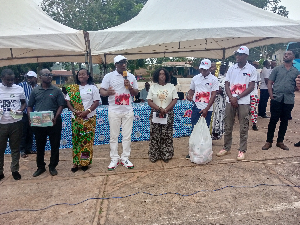
 Osabarima Ansah Sasraku III launched the Mount Sinai SHS Anti-Drug Club.
The Chief of Mamfe-Akuapem in the Eastern and Chairman of the JAPO RED Foundation, Osabarima Ansah Sasraku III, has launched an anti-drug club at the Mount Sinai Senior High School to empower students to become ambassadors against substance abuse.
The anti-drug club was launched on the premises of Mount Sinai Senior High School during a special assembly attended by the entire student body, school management, teaching and non-teaching staff, alongside officials of the Narcotics Control Commission (NACOC), the Ghana Education Service (GES), traditional and religious leaders, and representatives of the JAPO RED Foundation.
The initiative, launched on July 17, 2026, forms part of efforts to educate young people on the dangers of drug abuse and promote healthy lifestyles through peer education.
Twenty student volunteers were inducted into the club and presented with branded T-shirts, Lacoste shirts, caps and educational materials to support awareness campaigns on campus. The students, together with two teacher-patrons, are expected to lead anti-drug advocacy within the school community.
Speaking at the launch, Osabarima Ansah Sasraku III said the foundation's mission is to ensure that no student falls victim to drug abuse through sustained education and awareness.
He explained that the JAPO RED Foundation was established from a painful personal family experience after his relative, Samuel Akuffo Parry, popularly known as Japo Red, became addicted to marijuana while in secondary school.
According to the chief, what began as experimentation through peer influence eventually led to decades of addiction and mental illness, depriving the young man of a promising future.
He said the painful experience inspired the family to establish the foundation to prevent other young people from suffering a similar fate.
"This is not just another event. It is deeply personal. Our mission is to educate young people before addiction finds them, support affected families, remove the stigma surrounding mental health and restore hope," he stated.
Addressing the students, Osabarima Ansah Sasraku III urged them to reject peer pressure and resist attempts to experiment with drugs.
"The greatest danger about addiction is that it never introduces itself as addiction. It comes disguised as experimentation. Have the courage to say no to drugs because saying no today may allow you to say yes to an extraordinary future tomorrow," he advised.
He further called on parents, teachers, traditional leaders and religious leaders to create supportive environments where young people can openly seek guidance before making life-changing mistakes.
Eastern Regional Commander of the Narcotics Control Commission (NACOC), Principal Narcotics Control Officer Philomina Obenewaa Sackar, commended the JAPO RED Foundation for partnering with NACOC and the Ghana Education Service to educate students on drug abuse.
She said prevention through education remains the most effective strategy for addressing substance abuse among young people.
"The theme, 'Prevention Works: Building a Healthy, Drug-Free Generation,' reminds us that every young person we empower with the right information is one life protected and one future preserved," she said.
She encouraged the students to become ambassadors against drug abuse in their schools, homes and communities, stressing that choosing to stay away from drugs is a decision to protect their health, preserve their dreams and secure their future.
During a sensitisation session, Narcotics Control Officer Kwadwo Marfo Antwi, Akuapem North District Commander of NACOC, educated students on the Commission's mandate, the different categories of drugs, reasons behind substance abuse and their harmful effects.
He disclosed that the Commission had conducted three anti-drug operations in the Akuapem North Municipality since September last year, leading to the arrest of 12 suspected drug traffickers comprising nine men and three women, who are currently before the courts.
Marfo Antwi explained that NACOC's mandate extends beyond enforcement to include public education, counselling, rehabilitation referrals and the monitoring of precursor chemicals used in the manufacture of illicit drugs.
He warned that prolonged drug abuse can damage vital organs, including the liver and kidneys, impair judgment, fuel domestic violence, increase the risk of road traffic accidents and expose users to infectious diseases such as HIV and hepatitis through the sharing of needles and other risky behaviours.
He urged the students to stay away from drugs and use the knowledge acquired to educate their peers, noting that every young person who chooses a drug-free lifestyle contributes to building a healthier and safer Ghana.
The programme formed part of activities marking the International Day Against Drug Abuse and Illicit Trafficking under the theme, "Prevention Works: Building a Healthy, Drug-Free Generation."
It brought together stakeholders from the education, health, traditional and security sectors to reinforce the collective fight against substance abuse among Ghana's youth.

Copyright © 1994 - 2026 GhanaWeb. All rights reserved.










